Queen Media News Exclusive: The 2026 Space Coast Primary Post-Mortem and the Fall Horizon
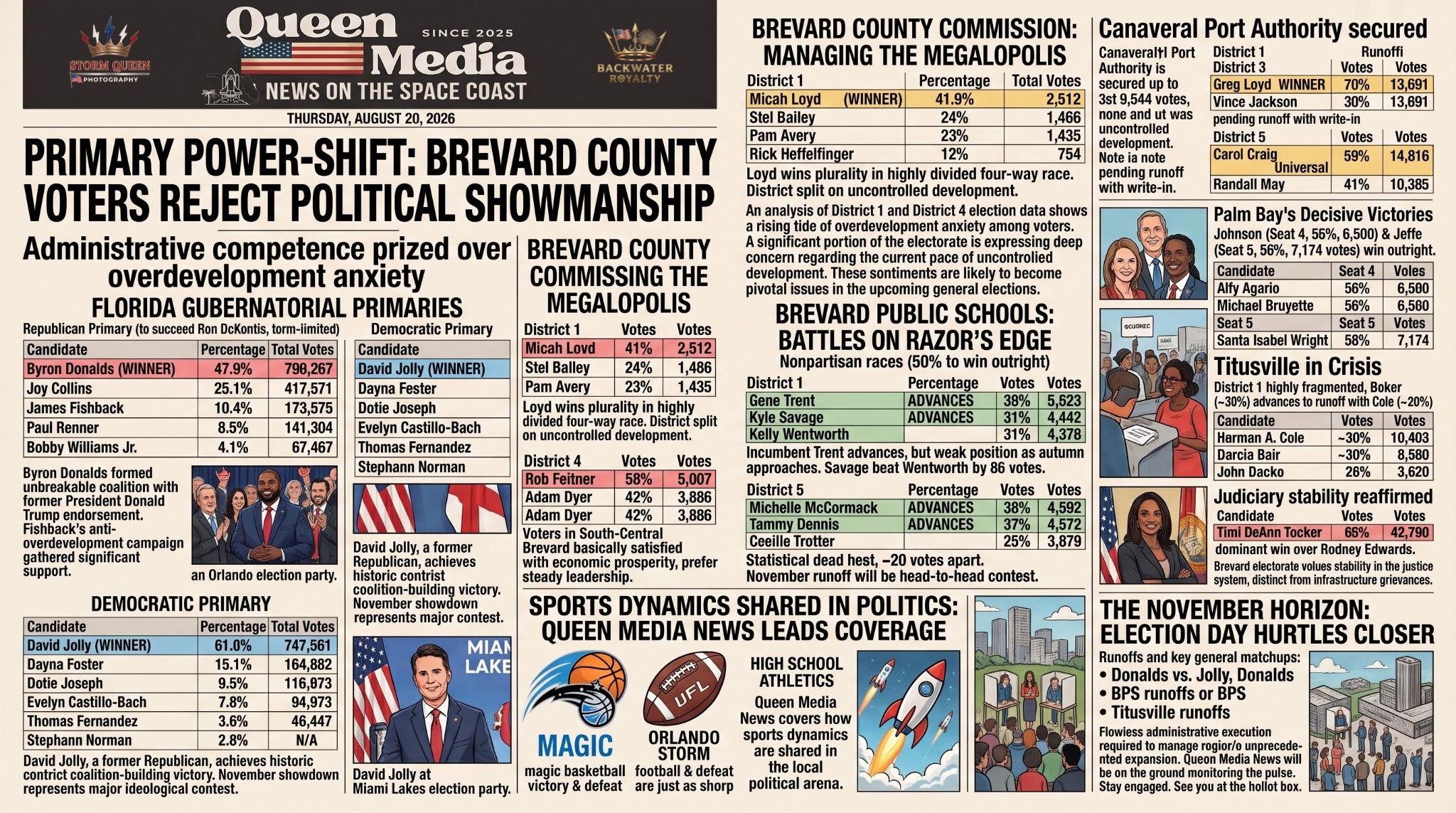
Queen Media News on the Space Coast is brought to you by Storm Queen Photography.
Florida sports have always been at the heart of the action on the Space Coast, with Queen Media News serving as the leading voice there through a combination of top-quality storytelling and professional coverage. Whether it's the exciting play on the hardwood with the Orlando Magic, the growing influence of the UFL Orlando Storm, or the intense Friday night games in local college and high school athletics, Queen Media News realizes that the dynamics of victory and defeat in sports are just as sharp and unyielding as those in the political world.
Championships in sports are the result of thorough preparation, the development of talent at the grassroots level, and the capacity to carry out the game plan even under intense and constant pressure. Now that the Space Coast is going through an unprecedented period of economic growth, aerospace revival, and serious strain on its infrastructure, the voters have shown that they want politicians who can produce tangible results. The Florida Primary Election held on August 18, 2026, was the final test of Brevard County's political leadership.
The main findings showed that the electorate is severely penalising administrative incompetence at the highly local level, is rejecting political showmanship, and is calling for immediate remedies in view of the region's rapid growth. Since the primary is now behind us and the number of candidates has been greatly reduced, the situation is now poised for a series of high-stakes runoff elections and huge general election battles this November.
The Core Issue: Infrastructure Fatigue and the Concrete Catalyst
If you want to really grasp the changing tectonic plates that will be at play in the forthcoming fall elections, then you need to understand the major physical and cultural shift that has taken place in Brevard County. Many years back, the political atmosphere of the Space Coast was characterised by a tough, down-to-earth libertarian attitude. For example, West Melbourne was joined together in 1959 specifically in order to prevent being absorbed by and subjected to excessive regulation from neighbouring municipalities, and it had a revenue system based solely on fees until it started charging property taxes in 2005. It was during this period that racing pioneers and mid-century outlaws worked as boat repairmen for Apollo astronauts by day and raced on dirt roads at night.
Now the mud bogs have been covered with concrete. On the Space Coast there is an absolute and unrelenting explosion of concrete pouring. Instead of having the quiet, rural way of life it once did, the area has been replaced by a shiny, carefully tended network of master-planned suburbs, luxury apartments, corporate coffee shops, and huge entertainment facilities. The most extreme and physically demanding sport in modern Brevard County is no longer dirt-track racing; it is now avoiding the orange traffic barrels on Minton Road without getting sideswiped by a cement mixer.
The rapid development has given rise to what we may call the "Concrete Catalyst". The large number of well-paid aerospace engineers, remote workers in the tech sector, and retirees coming from outside the state have greatly changed the voter list. Although this period of growth has brought about considerable economic prosperity, it has at the same time severely strained the local infrastructure. Voters are now suffering from severe "infrastructure fatigue". Once the planned replacement of the A1A Sebastian Inlet Bridge threatens to cause a serious parking shortage by 2032, or when a major highway begins to seem like an overcrowded runway, their patience disappears completely.
The electorate in 2026 firmly rejected artificial political talking points and called for genuine, capable managers who could alleviate this tangible fallout.
The Statewide Ripple Effect: The Gubernatorial Showdown
The day-to-day circumstances in Brevard County—such as those concerning zoning laws and the repair of potholes—are determined by hyper-local races, while the broader economic and regulatory environment is set by Tallahassee. The 2026 primary elections for Governor of Florida were highly divided contests on both sides of the aisle, aiming to succeed Ron DeSantis, who had served his term. For the Space Coast, the result of this election has a direct effect on the amount of state funding allocated to aerospace infrastructure, the Mars Horizon policy, and the large-scale environmental restoration projects for the Indian River Lagoon.
The Republican Ticket: Byron Donalds
On the Republican side, there were eleven candidates competing for the nomination.
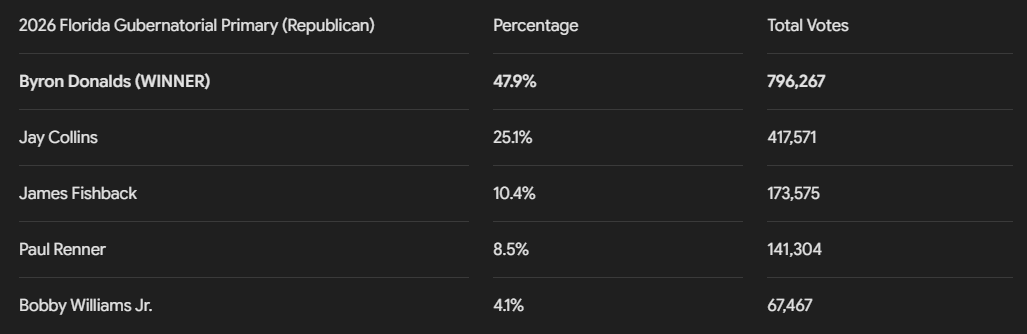
The data shows the top five results from the Republican primary for governor in Florida.
Byron Donalds, who has experience in finance and banking, won by a large margin with almost 48 per cent of the vote. At the party he held in Orlando on election night, Donalds roused his supporters and encouraged them to help him in building a state that is "truly accountable, achievable and affordable". He formed an unbreakable coalition by obtaining the support of former President Donald Trump and by running as a firm defender of fiscal sanity and a strictly limited federal government.
The idea that government intervention should be reduced matches exactly the requirements of the commercial aerospace industry based in Cape Canaveral, which shows that a possible Donalds administration would vigorously protect Florida's autonomy in both spaceport zoning and corporate taxation.
It is also worthwhile mentioning that James Fishback obtained 10.4% of the vote, having campaigned on the basis of concern that Floridians are seeing the state being taken over by overdevelopment, the disappearance of farmland, and a large number of data centres. The fact that he secured more than 173,000 votes across the state shows that anxiety about uncontrolled development is a major factor in elections—a feeling which will have a significant impact on this year's local runoff elections in Brevard.
The Democratic Ticket: David Jolly
On the Democratic side, the primary provided a fascinating account of political realignment.
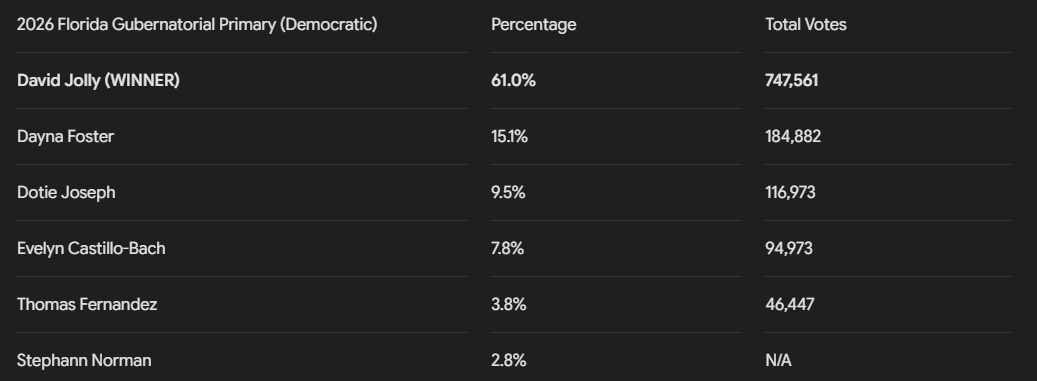
The data shows the results of the statewide Democratic primary for the position of Governor of Florida.
David Jolly crushed his main opponents and won the Democratic nomination by a huge margin of 61 per cent, which was based on just under 750,000 votes. The fact that Jolly has won means that a historic and highly unusual general election pairing will result.
Jolly was a Republican who served as a U.S. Representative for Florida's 13th Congressional District from 2014 until 2017 and notably resigned from the Republican Party due to ideological disagreements with the Trump administration, going on to co-found the Forward Party before deciding to stand for governor in 2026 on the Democratic side.
At the election night party he held in Miami Lakes, Jolly highlighted his decisive win by emphasizing the unique breadth of his appeal. He stated that the values which bring Floridians together are "big enough to allow us to form a coalition tonight and win the governorship in November". Jolly is trying to show that a former Republican who has switched parties can successfully hold the Democratic banner in a state which has not elected a Democratic governor since the late 1990s. He was able to move past opponents such as Evelyn Castillo-Bach—who campaigned on strongly progressive platforms including the banning of medical debt and cracking down on property insurance affiliates—by sticking to a practical and solutions-focused platform.
This November the contest between the Donalds and Jolly will represent a major ideological showdown, revealing whether the conservative consolidation in Florida remains unshaken or whether a centrist, coalition-building strategy is able to secure the governor's mansion.
County Commission: Managing the Megalopolis
On the Space Coast the main place in which the conflicts between rapid growth, property taxation, and historical preservation are settled is the Brevard County Board of County Commissioners.
District 1: The North Brevard Verdict
District 1 includes the northern part of Brevard County, which has Titusville and Mims among its towns. It functions as the important logistical base for the aerospace boom and is under severe, accumulating pressure in the areas of heavy launch logistics, employee housing, and the environmental health of the Indian River Lagoon.
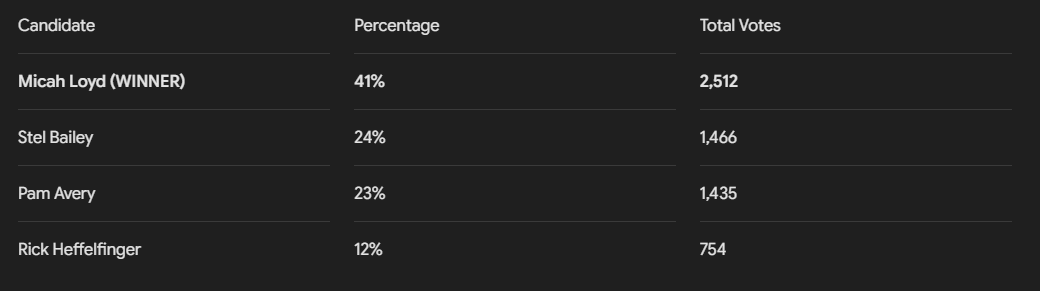
The precinct data for Brevard County Commission District 1.
In the highly divided four-way race, Micah Loyd achieved a clear 41% plurality and thus obtained 2,512 votes. Since a statistical deadlocked situation was avoided, the voters have given Loyd a definite route ahead. At the same time, the 59% obtained jointly by his opponents shows that the area is very much split. Realising this, Loyd will move on to the general election, aware that a majority of his district still holds a strong skepticism about uncontrolled development and so will have to carefully strike a balance between the corporate aerospace interests and the quality of life for residents.
District 4: Outright Victory in Viera
Modern Brevard County's demographic and commercial activity is centered on District 4, which is based upon the swiftly expanding area of Viera.

The precinct data for Brevard County Commission District 4.
Rob Feltner won the election with a strong 58 per cent share of the vote in a head-to-head contest that saw high turnout. Since he obtained more than half the votes, he won the seat without the need for a runoff in November. This decisive victory shows that the voters in South-Central Brevard are basically satisfied with the economic prosperity brought about by the region's growth, on the condition that it is guided by experienced and steady leadership rather than by reactionary groups who want to stop development altogether.
The Fall Battlegrounds: Brevard Public Schools Board
The ideological heartbeat of a community is most clearly seen and most easily disrupted in its school board elections. In the last few years the Brevard Public Schools (BPS) system has been at the center of intense controversies concerning curriculum, parental rights, student discipline, and administrative bloat. The 2026 primary showed an electorate who were worn out and whose only concern was administrative competence and stability.
Since in nonpartisan school board elections a candidate has to obtain more than 50 per cent of the vote to win directly, two of these elections have not produced a clear winner and are therefore going to contested, high-stakes runoffs on the November ballot.
District 1: The Razor's Edge

The precinct data for Brevard County School Board District 1.
Megan Wright, the incumbent, withstood a very close challenge from Tara "Coach T" Gibson and secured victory by just 2 per cent—a dangerously narrow lead of fewer than 200 votes. Although she has just missed out on having to face a runoff by reaching the 51 per cent mark, the fact that the vote totals were so nearly equal indicates that she will have to be highly conscious in the future when dealing with board policies, knowing that half of her district is deeply dissatisfied and is ready to take action.
District 2: The November Showdown
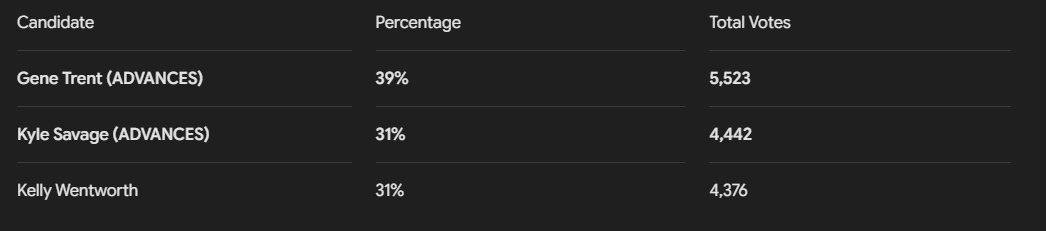
The precinct data for Brevard County School Board District 2.
In District 2, the current holder of the office, Gene Trent, received only 39% of the vote. Since he did not reach the necessary 50% threshold, he will have to fight Kyle Savage in a runoff election in November, Savage having just won the second position over Kelly Wentworth by a margin of 66 votes. The fact that 62% of voters voted against the incumbent shows that Trent is in a very weak position as the autumn election approaches. The contest will involve a tough ground campaign over the next three months.
District 5: The Statistical Dead Heat
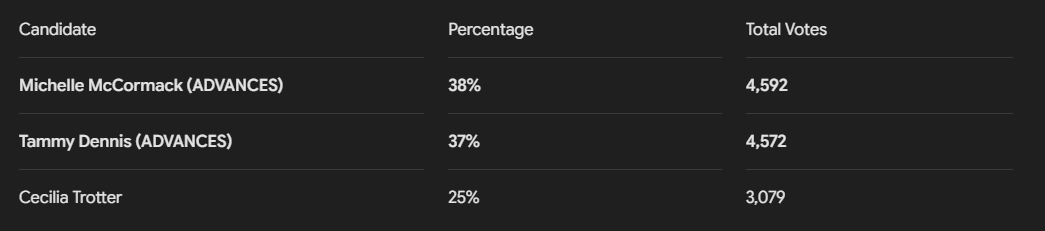
The precinct data for the Brevard County School Board District 5.
District 5 is a statistical dead heat; Michelle McCormack has just edged Tammy Dennis by a tiny margin of 1 per cent, which amounts to a difference of exactly 20 votes out of the more than 12,000 votes cast. Since neither woman obtained a majority, they will proceed to a head-to-head contest in the November general election. Cecilia Trotter's 25 per cent share of the electorate served as the decisive spoiler in this case, and both McCormack and Dennis will devote the entire fall to actively attracting Trotter's orphaned voters in order to win the seat.
Securing the Economic Engine: Canaveral Port Authority
Port Canaveral is the principal economic asset of the Space Coast, since it is the world's busiest cruise port and serves as the key maritime logistics centre for the recovery of commercial space boosters, making the administration of the Canaveral Port Authority a matter of global importance.
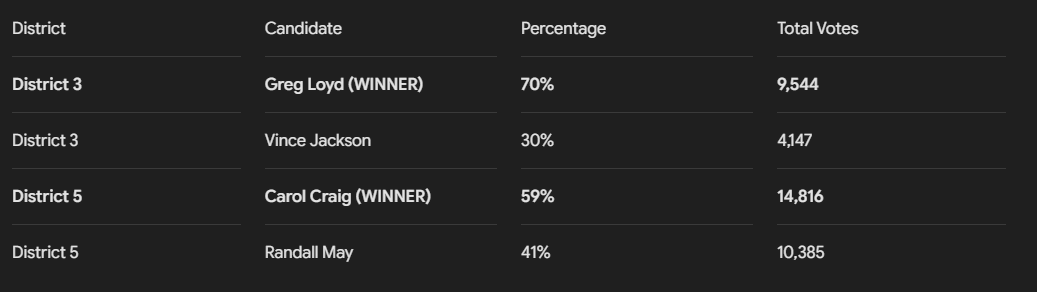
The precinct data for Districts 3 and 5 of the Canaveral Port Authority.
Carol Craig, the current holder of the position, won the District 5 Universal Primary Contest with 59% of the vote against Randall May. Since it was a universal primary, this clear mandate means that she wins the seat without any further contest.
In District 3, Greg Loyd won absolutely by 70 per cent of the vote against Vince Jackson. The race is not yet over, though, since there is a write-in candidate on file for that district and as a result Loyd’s victory in the primary only serves to get him on the general election ballot this November where he will have to face off against the write-in candidate.
Municipal Action: Palm Bay and Titusville
Palm Bay: Decisive Victories for the Sleeping Giant
In Palm Bay, the most populous city in Brevard County, the voters showed complete clarity. The city has in the past had difficulty in building up a commercial tax base that matches its extensive residential sprawl.
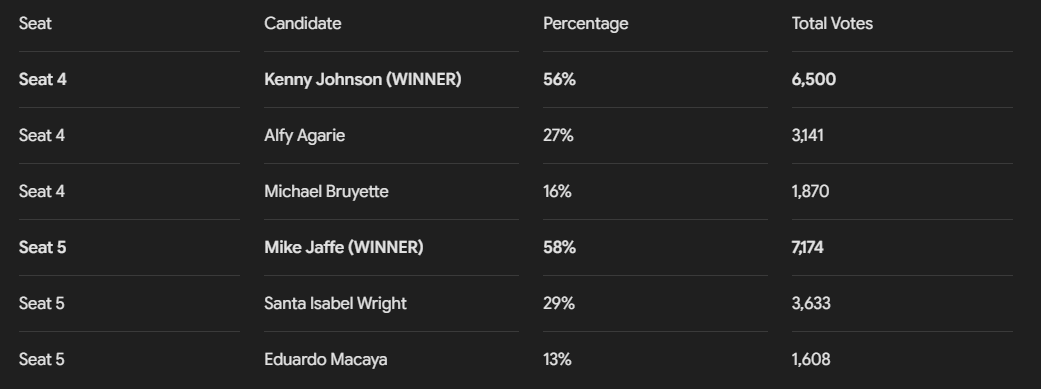
The precinct data for City Council seats 4 and 5 in Palm Bay.
Kenny Johnson (Seat 4) and Mike Jaffe (Seat 5) each obtained 56 per cent and 58 per cent of the vote respectively and thus won their elections outright despite facing several challengers. They are avoiding the November election, having been given the authority by the electorate to vigorously promote high-revenue commercial development and important infrastructure improvements.
Titusville: The Gateway to the Stars in Crisis
Titusville is at the heart of the Space Coast and is now going through serious difficulties due to the aerospace boom.
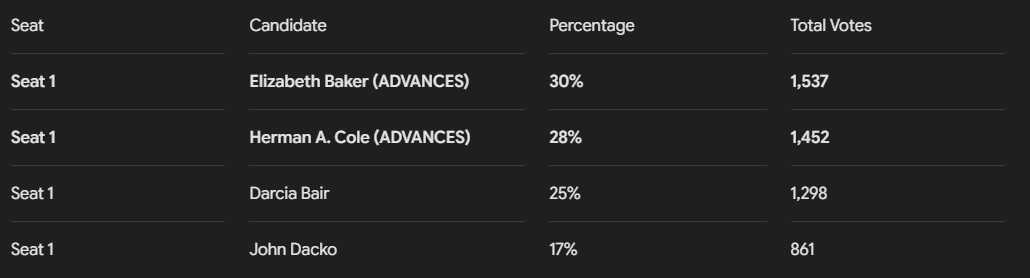
The precinct data for the first seat on the Titusville City Council.
The race for the Seat 1 position on the Titusville City Council was highly fragmented and involved four candidates, highlighting the city's conflict between preserving its history and pursuing rapid aerospace expansion. Elizabeth Baker won with a slim lead of 30 per cent, beating Herman Cole by less than 100 votes. Since no candidate obtained a majority, the race will now proceed to a heated runoff in November, during which Baker and Cole will need to form a governing coalition street by street.
The voters of Titusville also need to get ready for the City Council Seat 3 contest this fall, since only two candidates have qualified for that seat and so the primary has been skipped, the race appearing directly on the November General Election ballot.
The Judiciary: Experience Over Emotion
On the Space Coast, judicial elections have in the past been characterised by a strict adherence to the law, to order, and to a great deal of courtroom experience.

The precinct data for the Brevard County Judge, Group 3.
The fact that Timi DeAnn Tucker achieved an overwhelming victory with 68 per cent of the vote in the Brevard County Judge, Group 3, position represents the most statistically dominant win in the county during the primary election. Since she received more than 42,000 votes, she won the seat unopposed, which shows that the Brevard electorate clearly separates its grievances about infrastructure from those concerning the mechanics of the justice system and places a high value on stability among the judges.
The November Horizon
The primary held on August 18 acted as a definitive stress test, eliminating dozens of candidates and securing several important municipal and judicial positions. The remaining candidates now have to go through the harsh race of the general election.
From the historic, ideological showdown for the governor's mansion between Byron Donalds and David Jolly, to the incredibly fragile mandates in the BPS and Titusville runoffs, November will decide the exact trajectory of the Space Coast for the rest of the decade.
To win this fall, candidates cannot simply rely on rhetoric; they must prove they possess the flawless administrative execution required to manage this region's unprecedented expansion. Queen Media News will be on the ground, monitoring the pulse of these critical matchups as Brevard County hurtles toward Election Day. Stay engaged, do your research, and we'll see you at the ballot box.
Queen Media News on the Space Coast is brought to you by Storm Queen Photography.
