The Cost of Hubris: How Pandemic Overreach Broke the Economy and Public Trust
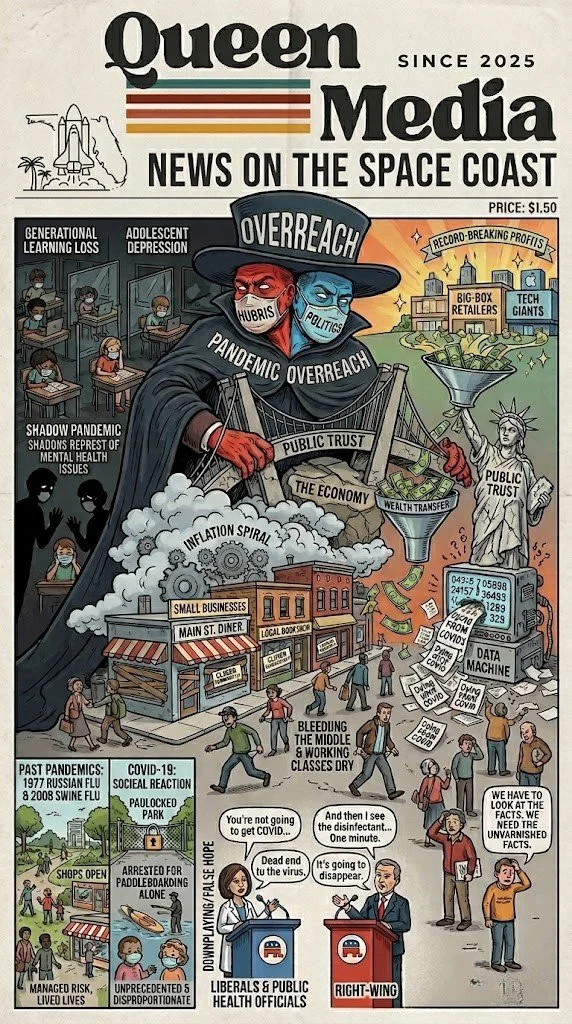
We are now far enough removed from the height of the COVID-19 pandemic to take a sobering, objective look at what actually happened. As independent voter, I don't have the luxury of retreating into partisan echo chambers to lick our wounds or rewrite history. We have to look at the facts. And the facts tell a difficult story: the prolonged periods of hiding, isolation, and economic shutdowns inflicted catastrophic collateral damage on our families and our economy.
Furthermore, the public trust was shattered not just by the virus, but by leaders on both sides of the aisle who chose political hubris over scientific humility, muddying the waters with absurd statements, misconstrued data, and broken promises.
The True Cost of "Hiding"
What began as a reasonable "15 days to slow the spread" morphed into months—and in some places, years—of rolling lockdowns, school closures, and forced isolation. We were told that hiding was the only moral option, but the bill for that isolation is now due, and it is devastating.
The economic fallout was not a shared burden; it was a massive upward transfer of wealth. While big-box retailers and tech giants saw record-breaking profits, hundreds of thousands of small businesses—the backbone of the American economy—were permanently shuttered. Supply chains were broken, triggering an inflationary spiral that is still bleeding the middle and working classes dry today.
But the destruction of the economy pales in comparison to the toll taken on the American family. Prolonged isolation fueled a shadow pandemic of mental health crises, substance abuse, and domestic strain. Our children were forced out of classrooms and behind screens, resulting in generational learning loss and a spike in adolescent depression that pediatricians are still struggling to manage. We sacrificed the social, educational, and psychological well-being of a generation under the guise of keeping them entirely separated from a virus that, ultimately, almost everyone caught anyway.
A Bipartisan Bankruptcy of Leadership
If we are going to hold leaders accountable, we have to call out the absurdity from across the political spectrum. In the early days of the pandemic, right-wing politicians frequently downplayed the severity of the virus, offering false hope and medical nonsense instead of steady leadership.
Here is just a sample of the reckless rhetoric from the right:
President Donald Trump falsely promising it would magically vanish in February 2020: "It’s going to disappear. One day, it’s like a miracle, it will disappear."
Texas Lt. Governor Dan Patrick suggesting in March 2020 that senior citizens should be willing to risk death to keep the economy running: "Those of us who are 70-plus, we'll take care of ourselves. But don't sacrifice the country."
Meanwhile, liberal politicians and public health officials shattered their own credibility by overselling the capabilities of the vaccines. Let me be clear: I am not anti-vaccine. The data shows the vaccines provided crucial protection against severe illness and death for the vulnerable. But they did not stop transmission, despite leading officials explicitly promising they would:
President Joe Biden stated unequivocally in July 2021: "You’re not going to get COVID if you have these vaccinations." * CDC Director Dr. Rochelle Walensky said in March 2021: "Our data from the CDC today suggests that vaccinated people do not carry the virus, don't get sick."
Dr. Anthony Fauci stated in May 2021: "When you get vaccinated... you become a dead end to the virus."
When leaders downplay a virus as a "miracle" that will vanish, or mandate vaccines based on the false promise that they are a foolproof shield against transmission, the public rightly stops listening.
The Crisis of Data: Dying "With" vs. Dying "From"
Adding to the erosion of trust was the gross mismanagement of the data itself. For a large portion of the pandemic, public health agencies and hospitals conflated dying from COVID-19 with dying with COVID-19.
Because hospitals routinely tested every admitted patient, individuals who died from entirely unrelated causes—like late-stage cancer, heart attacks, or even fatal accidents—were often logged as "COVID deaths" simply because they happened to test positive for the virus at the time of death. This lack of precision was infuriating. Instead of providing the public with transparent, nuanced data to assess their actual personal risk, the numbers were muddled, feeding conspiracy theories and making objective analysis nearly impossible.
Panic vs. Perspective: The Historical Context
To truly understand how far we overreacted with our societal shutdowns, we have to look at the numbers in the context of recent history.
In 1977, the "Russian Flu" (an H1N1 strain) swept the globe, hitting children and young adults particularly hard, and ultimately killing an estimated 700,000 people worldwide. In 2009, the Swine Flu (another H1N1 strain) caused a global pandemic that killed up to 575,000 people.
COVID-19 was certainly more severe, with official global deaths reaching around 7 million over several years. But the societal reaction was completely unprecedented and largely disproportionate. During the Russian Flu and the Swine Flu, we did not shut down the global economy. We didn't padlock public parks, arrest people for paddleboarding alone in the ocean, or force toddlers to wear cloth masks while trying to learn to speak. We managed the risk and lived our lives.
The Path Forward
As Americans, we demand better. We recognize that navigating a once-in-a-century pandemic is incredibly difficult. But the path forward cannot be built on rewriting history or excusing the failures of "our team."
We have to acknowledge that keeping kids out of schools and shutting down local economies caused deep, lasting harm. We have to admit that both minimizing the virus and overpromising on the vaccines created a massive crisis of credibility. We don't need politicians who claim to have all the perfect answers or who treat data as a tool for political manipulation. We need leaders who have the courage to treat us like adults, give us the unvarnished facts, and trust us to rebuild our families and our economy.
