The Dark Eagle at Cape Canaveral: New Weapons, Historical Bullseyes, and Defending the Space Coast
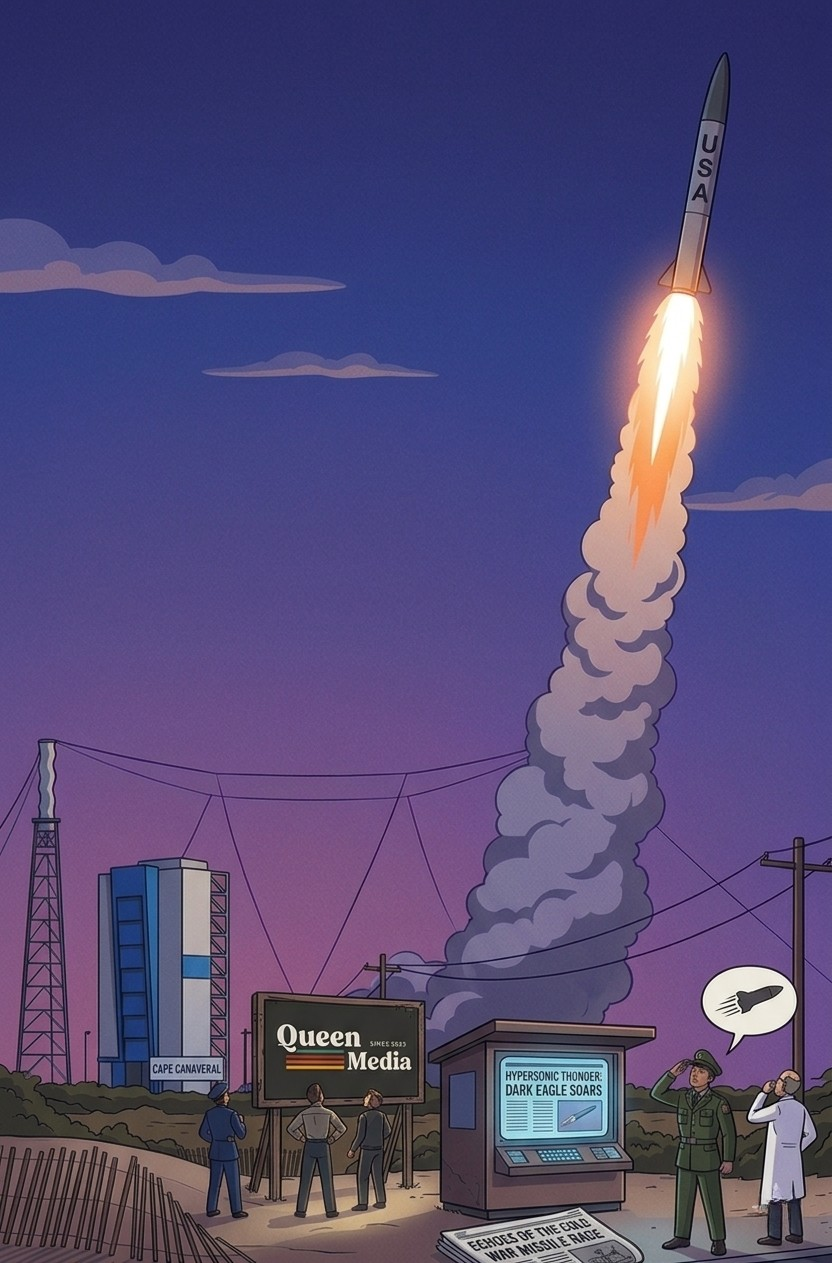
If you’ve spent any time on Florida’s Space Coast recently, you know the skies are crowded. Between commercial rocket launches and routine satellite deployments, the rumble of aerospace technology is just a part of the local weather. But recently, a different kind of thunder has echoed from Cape Canaveral Space Force Station—one that speaks less to the commercialization of space and more to a high-stakes geopolitical chess match.
The U.S. military has been testing its new Long-Range Hypersonic Weapon (LRHW), ominously and aptly named the Dark Eagle.
While the technology is undeniably 21st-century, the anxiety driving it—and the sandy Florida launch pads hosting it—feel like a distinct echo of a bygone era. We’ve been here before.
What is the Dark Eagle?
The Dark Eagle is the U.S. Army’s answer to the hypersonic arms race. Jointly developed with the Navy, it is a surface-to-surface missile designed to launch from a mobile transporter-erector-launcher (essentially, a massive, highly modified truck and trailer).
Here is what makes it formidable:
* The Speed: It travels well in excess of Mach 5 (over 3,800 mph).
* The Maneuverability: Unlike a traditional Intercontinental Ballistic Missile (ICBM) that flies in a predictable, parabolic arc into space and back, the Dark Eagle uses a "boost-glide" vehicle. The rocket motor pushes it up, and then the warhead detaches and glides through the upper atmosphere, maneuvering erratically to dodge enemy radar and interceptors.
* The Range: Recent disclosures indicate its range is at least 2,175 miles, allowing the U.S. to strike heavily defended targets—like anti-aircraft networks and command nodes—from far outside the "danger zone."
After years of development delays and aborted tests, the Dark Eagle finally hit its stride with successful end-to-end live-fire tests from Cape Canaveral in late 2024 and mid-2025, paving the way for operational deployment.
Echoes of the Cold War
When we look at the Dark Eagle's development—rushed timelines, fear of falling behind adversaries (in this case, China and Russia), and dramatic test flights off the Florida coast—it’s impossible not to experience a sense of historical déjà vu.
The Early Missile Race
In the 1950s, Cape Canaveral was the cradle of the early Cold War missile rush. The U.S. was desperate to match the Soviet Union's rocketry. Before the reliable Atlas and Titan ICBMs became the backbone of American deterrence, the military tested early, experimental cruise missiles like the Snark. The Snark was so notoriously unreliable and crashed into the Atlantic so often that the waters off Cape Canaveral were jokingly referred to as "Snark-infested waters."
The Dark Eagle’s early teething problems and scrubbed launches are a modern reflection of this old reality: pushing the absolute edge of physics is a messy, trial-and-error process.
The Pershing Parallel
Perhaps the closest historical cousin to the Dark Eagle is the Pershing II missile of the 1980s. Like the Dark Eagle, the Pershing II was a mobile, ground-launched, intermediate-range weapon. It wasn't about blowing up the whole world; it was about terrifying speed and precision. The Pershing II could be launched from the back of a truck in Western Europe and strike Soviet command bunkers in minutes.
Its deployment was highly controversial and triggered immense anxiety in Moscow, precisely because it was too fast to defend against. Today, the Dark Eagle is being designed to serve a remarkably similar psychological and tactical purpose in the Indo-Pacific theater: a mobile, un-interceptable "silver bullet" that forces adversaries to rethink their defensive strategies.
The Bullseye We Already Wear
For locals, the rumble of these new weapons sometimes sparks anxiety about painting a target on Florida's Space Coast. But the hard truth is that this part of the U.S. has always been a prime target for a nuclear attack.
Testing the Dark Eagle isn’t making us a target—we already are. Between Cape Canaveral, Kennedy Space Center, and the surrounding, highly concentrated military infrastructure, this region has been circled on strategic strike maps for decades.
If anything, the deployment of next-generation offensive weapons from our shores highlights a glaring need for localized defense. For those who grew up here, it makes a strong case that Patrick Space Force Base needs to be equipped with stationed fighter jets, just like the skies we remember from the 1990s. If the Space Coast is going to host the military's most advanced deterrents, it needs the immediate, defensive airpower to match it.
The Bottom Line
The Dark Eagle represents a massive leap in aerospace engineering. The materials required to survive the blistering friction of hypersonic flight, combined with the guidance systems needed to steer through plasma fields, are modern marvels.
Yet, the column of fire rising over Cape Canaveral tells an older story. It’s the story of a superpower relying on the cutting edge of science to maintain a fragile balance of power. The missiles are faster, and the math is harder, but the fundamental game of deterrence remains exactly the same.
