The Lunar Renaissance and the Mars Horizon: An Exhaustive Analysis of the 2026 Federal Space Policy and Its Impact on Florida's Space Coast
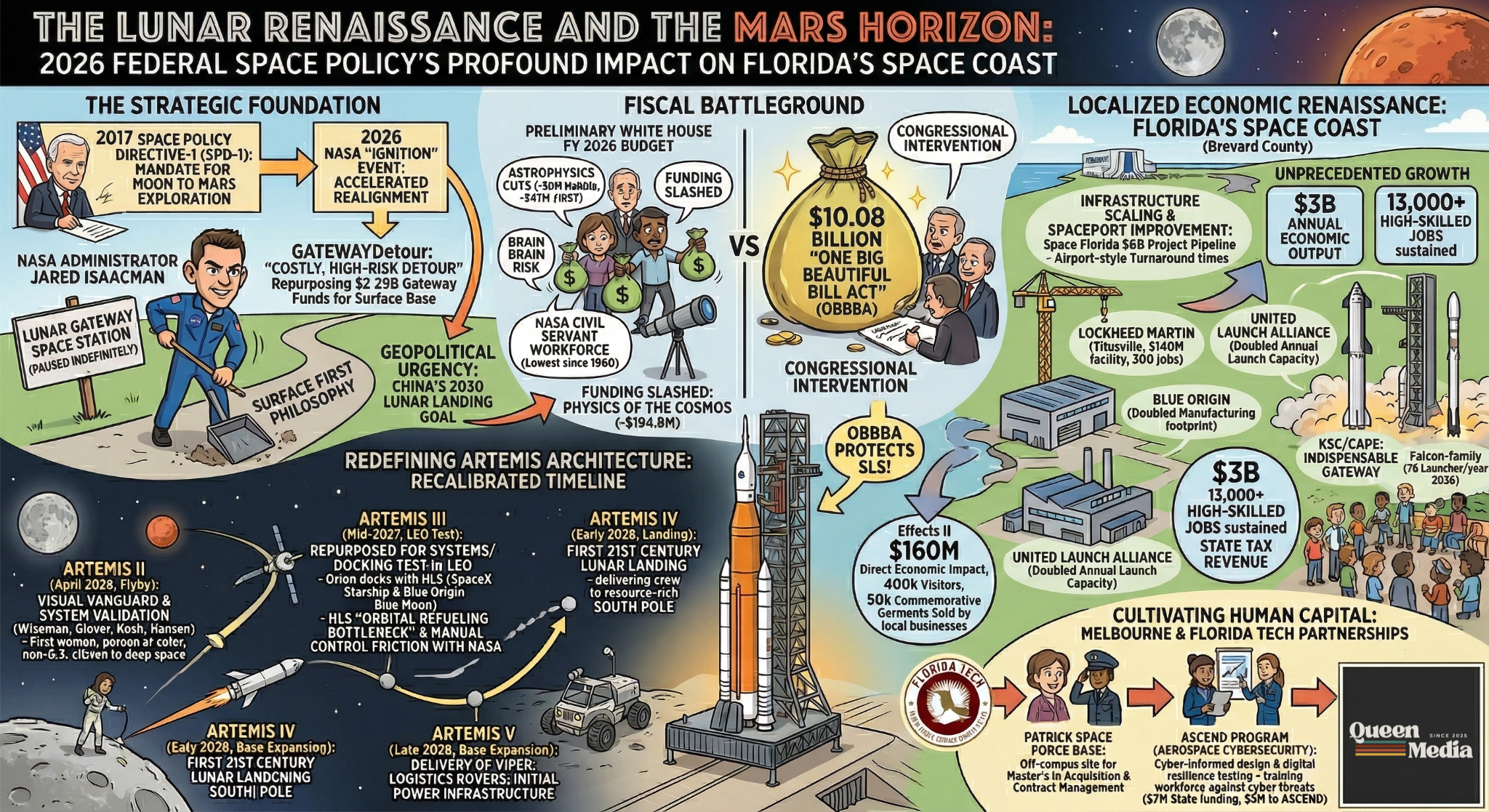
The successful launch of the Artemis II mission on April 1, 2026, represents a profound inflection point in the trajectory of human spaceflight, concluding a 53-year hiatus of crewed lunar exploration and inaugurating a highly accelerated era of deep-space operations. As the four astronauts—Commander Reid Wiseman, Pilot Victor Glover, and Mission Specialists Christina Koch and Jeremy Hansen—orbit the Earth aboard the Orion spacecraft in preparation for a translunar injection burn, the operational, fiscal, and strategic realities of the American space program are undergoing a systemic transformation. This mission serves as the visible vanguard of a much broader realignment of federal space policy, budgetary allocations, and architectural frameworks. Driven by the current administration and National Aeronautics and Space Administration (NASA) Administrator Jared Isaacman, this realignment seeks to exponentially accelerate lunar surface operations, redefine commercial partnerships, and lay the concrete, technological groundwork for crewed Martian exploration by the end of the decade.
For Florida’s Space Coast, and specifically the technological and economic corridors spanning from the Kennedy Space Center through Titusville, Cape Canaveral, and Melbourne, these federal shifts are not mere theoretical adjustments emanating from Washington, D.C. Rather, they are direct catalysts for regional economic expansion, unprecedented infrastructure development, and a massive revitalization of the local aerospace workforce. The convergence of the foundational 2017 Space Policy Directive-1 (SPD-1) with the modern-day mandates established during the 2026 "Ignition" event presents a complex matrix of challenges and historic opportunities. This comprehensive research report provides an exhaustive, multi-layered analysis of these evolving federal space policies, the intricate battles surrounding the Fiscal Year (FY) 2026 budget—including the transformative "One Big Beautiful Bill Act" (OBBBA)—the heavily restructured Artemis timeline, and the profound economic, educational, and operational implications for Queen Media's readership across Florida's Space Coast.
The Strategic Foundation: From Space Policy Directive-1 to the "Ignition" Mandate
To thoroughly comprehend the current trajectory of NASA and the ensuing local impacts on the Space Coast, one must first trace the architectural origins back to December 11, 2017, when the foundational framework of the modern American space program was fundamentally redirected through the signing of Space Policy Directive-1 (SPD-1). Amending the 2010 National Space Policy—which had previously canceled the George W. Bush-era Constellation Program in favor of an Asteroid Redirect Mission—SPD-1 officially mandated a U.S.-led, integrated program designed to return humans to the Moon for long-term exploration and utilization, explicitly positioning lunar operations as the precursor to human missions to Mars.
This directive formally codified the philosophy that the lunar surface must serve as the essential proving ground for the technologies, hardware, and biological mitigations required for interplanetary travel. However, the process of translating the high-level geopolitical ambitions of SPD-1 into a functional, actionable, and fiscally responsible architecture required years of iterative development. This evolution culminated in a massive strategic overhaul announced in March 2026 during a full-day NASA headquarters event dubbed "Ignition".
Under the aggressive leadership of NASA Administrator Jared Isaacman, the agency recognized that the existing Artemis timeline and architectural structure were structurally incapable of countering the accelerating pace of global space competitors. Specifically, the looming geopolitical reality of China’s stated intent to land taikonauts on the lunar surface by 2030 injected a sense of severe urgency into the American program, prompting Isaacman to declare that "the clock is running in this great-power competition, and success or failure will be measured in months, not years".
The "Surface First" Realignment and the End of Gateway
The most consequential policy shift emerging from the 2026 Ignition event was the introduction of a pragmatic, "Surface First" philosophy that aggressively prioritizes direct lunar base construction over the assembly of orbital waystations. The primary architectural casualty of this sweeping shift was the Lunar Gateway space station. Originally conceived as a complex, Moon-orbiting habitat and logistics outpost designed to facilitate lunar landings, Gateway was increasingly viewed by the new administration and industry advocates, such as the Mars Society, as a costly, high-risk detour that added unnecessary complexity to both Moon and Mars missions.
By officially pausing Gateway indefinitely and functionally sidelining the program, NASA is now redirecting its massive internal resources, as well as highly specialized international contributions, directly to the lunar surface. Critical, multi-billion-dollar components that were currently being manufactured by international partners for the Gateway orbital station are now slated to be heavily modified and repurposed for the permanent Moon base. These globally sourced assets include Canada’s Canadarm3 robotic arm, an advanced airlock built by the United Arab Emirates, sophisticated habitation and refueling modules designed by the European Space Agency (ESA), and advanced life-support systems engineered by Japan.
This strategic realignment, now spearheaded by the newly appointed Moon Base Program Executive Carlos Garcia-Galan—who formerly served as the deputy manager of the Gateway program—envisions a strictly phased, incremental approach to lunar settlement. Phase 1 focuses on establishing reliable surface access through regular, frequent commercial and robotic deliveries. Phase 2 involves the intermediate expansion of physical infrastructure and the delivery of higher payload capacities. Phase 3 culminates in the establishment of a semi-permanent to permanent human presence, featuring pressurized rovers and nuclear power systems. This phased approach fundamentally alters NASA's historical operational cadence, shifting the agency from executing isolated, monolithic exploration missions to managing a continuous, high-volume logistics pipeline closely resembling the Commercial Resupply Services that sustain the International Space Station (ISS).
The Fiscal Battleground: The FY 2026 Budget Request versus the OBBBA
The highly ambitious, accelerated mandates of the Ignition strategy cannot be realized in a vacuum; they require sustained, robust, and highly directed federal funding. The budgetary environment leading into the FY 2026 appropriations cycle was initially characterized by severe fiscal austerity, widespread programmatic uncertainty, and the threat of a devastating hollowing out of the American aerospace workforce.
The preliminary White House budget proposal for FY 2026 sought to significantly curtail federal spending across the sciences. The proposal threatened to reduce NASA’s civil servant workforce—measured in Full-Time Equivalent (FTE) hours—to its lowest baseline levels since July 1960, the very dawn of the space age. This proposed contraction sparked immediate and widespread concern regarding a potential "brain drain," where highly specialized scientists, engineers, and aerospace professionals would be forced to seek employment in entirely different industries or relocate overseas to support more heavily funded, stable international space programs.
Furthermore, the initial executive budget proposal severely curtailed astrophysics, heliophysics, and planetary science funding, directly prioritizing human spaceflight at the extreme expense of robotic and observational science. The Hubble Space Telescope budget was slated to be reduced from $93.3 million to $85.0 million, and the James Webb Space Telescope budget was targeted for a reduction from $187.0 million to $140.0 million. More drastically, funding for the "Physics of the Cosmos" program was proposed to be slashed from $196.3 million down to a mere $1.5 million, and the Geospace Dynamics Constellation (GDC) project was proposed for complete termination and orderly shutdown.
The Congressional Intervention: The "One Big Beautiful Bill Act"
The dire fiscal landscape and the threat to legacy aerospace infrastructure were drastically altered by a massive, unprecedented legislative intervention in the form of the "One, Big Beautiful Bill Act" (OBBBA). Functioning as a reconciliation bill spearheaded by the Senate Commerce, Science, and Transportation Committee—and heavily championed by Senator Ted Cruz (R-TX)—the OBBBA bypassed standard appropriations gridlock to inject massive, multi-year funding directly into NASA's most critical infrastructure.
The OBBBA allocates a staggering $10.08 billion for NASA programs over several years, explicitly and forcefully contradicting earlier executive proposals that sought to scale back or terminate legacy human spaceflight elements in favor of purely commercial alternatives. This legislation represents a definitive congressional mandate to maintain the established aerospace industrial base, heavily benefiting the traditional defense contractors and highly skilled workforces concentrated heavily along Florida's Space Coast and in Texas.
To fully grasp the magnitude of this legislative rescue, it is necessary to examine the specific structured allocations mandated by the OBBBA for the FY 2026 to FY 2030 timeframe:
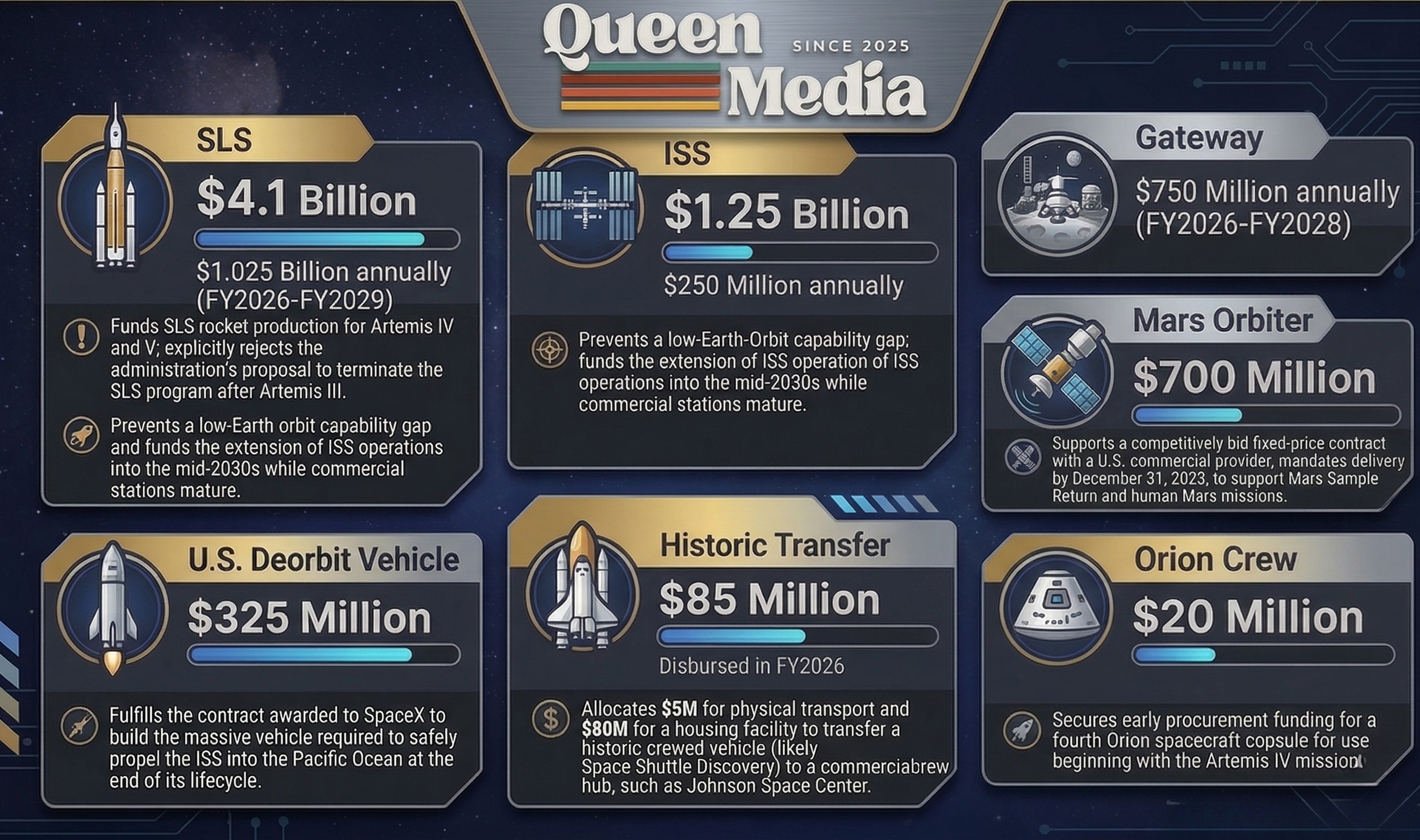
The passage of the OBBBA, when combined with the standard FY 2026 appropriations, provides NASA with its largest aggregate budget in nearly three decades. Administrator Isaacman has publicly committed to executing the spending plan in strict accordance with the congressionally mandated appropriations, securing the financial runway necessary to maintain the Artemis mission cadence without sacrificing the highly specialized workforce required to execute it. Moreover, the OBBBA's explicit protection of the SLS ensures that the launch infrastructure at Kennedy Space Center remains highly active, cementing Brevard County's status as the indispensable gateway for American deep-space operations.
Redefining the Artemis Architecture: Mission Cadence and Commercial Realities
With massive federal funding secured through the OBBBA and a revised strategic objective strictly focused on continuous surface colonization rather than orbital waystations, NASA has significantly and aggressively restructured the immediate Artemis mission manifest.
The previous architecture, which was designed prior to the 2026 Ignition event, envisioned Artemis III executing a direct lunar landing in 2028. Because Artemis II was scheduled for 2025/2026, this plan resulted in a highly risky, multi-year gap between human flights. Administrator Isaacman publicly labeled this previous trajectory a failure in maintaining the necessary "muscle memory" for ground crews, launch directors, and astronauts, identifying it as an unacceptably high-risk operational profile. Consequently, the Artemis timeline has been recalibrated to feature much more frequent launches, a strict standardization of vehicle configurations, and a phased approach that incrementally retires technical risk through rigorous in-orbit testing prior to committing to a lunar landing.
The Restructured Artemis Manifest (2026–2028)
Artemis II (April 2026): Currently in the execution phase, this historic 10-day mission serves as the critical validation flight for the Orion spacecraft's environmental life-support systems, deep-space navigation, and high-bandwidth communications infrastructure. Executing a complex free-return trajectory that brings the diverse crew—representing the first woman, person of color, and non-U.S. citizen to travel to deep space—within 5,000 miles of the lunar far side, the mission is absolutely essential for verifying proximity operations and manual handling characteristics before attempting future dockings.
Artemis III (Mid-2027): In what is arguably the most significant architectural pivot of the 2026 policy shift, Artemis III will no longer attempt a lunar landing. Recognizing the severe developmental delays in commercial landers, NASA has expedited the mission to mid-2027 and repurposed it to serve as an extensive systems and docking test strictly in low-Earth orbit (LEO). The crew will practice highly complex, high-speed rendezvous and docking procedures with one or both of the commercially developed Human Landing Systems (HLS)—SpaceX’s massive Starship and Blue Origin’s Blue Moon lander. Furthermore, this mission will provide the first crucial in-space testing of the new Axiom Extravehicular Mobility Unit (AxEMU) spacesuits and validate integrated life support across the docked Orion and HLS vehicles.
Artemis IV (Early 2028): Now formally designated as the first crewed lunar landing of the 21st century, Artemis IV will deliver astronauts to the rugged, resource-rich lunar south pole. The success of this mission relies entirely on the successful validation of the HLS architecture tested during the preceding Artemis III orbital mission.
Artemis V (Late 2028): Capitalizing on the newly mandated biannual cadence established by the Ignition policies, Artemis V will rapidly expand upon the initial surface capabilities established by Artemis IV. This mission is slated to deliver the early, heavy elements of the permanent lunar base, including uncrewed logistics rovers, the VIPER resource exploration rover, and critical initial power infrastructure.
The Friction of Commercial Integration and the HLS Bottleneck
While the accelerated timeline is politically bold and fiscally supported by the OBBBA, it remains precariously dependent on the performance of private commercial partners, leading to notable and escalating institutional friction between NASA and the commercial spaceflight sector.
The primary technological bottleneck in the revised Artemis architecture is the development and certification of SpaceX's Starship HLS. To successfully execute a lunar landing, the Starship architecture requires unprecedented, highly complex orbital refueling operations. Because of its immense size, the Starship HLS requires approximately ten separate tanker launches to fill a propellant depot in low-Earth orbit before the landing vehicle has sufficient delta-v to depart for the Moon. NASA's Office of Inspector General (OIG) has repeatedly cited these massive operational complexities and launch cadence requirements as severe schedule risks that threatened the original 2028 landing date.
Furthermore, profound technical disagreements have emerged publicly between NASA and SpaceX regarding the agency's strict manual control requirements for the landing sequence. Formal program review documents from early 2026 reveal a deep, systemic dispute over whether SpaceX's highly automated landing approach meets NASA's safety intents for human-in-the-loop manual overrides. Drawing direct parallels to similar multi-year disputes that occurred during the certification of the Crew Dragon capsule, aerospace analysts note that this level of disagreement threatens to disrupt the Artemis IV target date, as such disputes generally require either extensive vehicle redesigns or heavily negotiated safety waivers.
This commercial friction provides vital context for understanding the 2026 policy shifts. NASA's decision to shift Artemis III to an orbital docking test acts as a highly strategic risk-mitigation maneuver. By removing the landing requirement from Artemis III, NASA provides its commercial partners additional time to achieve certification and solve the orbital refueling problems without halting the overall momentum of the SLS and Orion production lines, thereby maintaining political support and continuous economic investment.
Laying the Interplanetary Groundwork: The Moon to Mars Architecture
While the immediate economic and operational focus naturally remains on the Artemis lunar landings, the ultimate, long-term objective of the 2017 Space Policy Directive-1 and the 2026 Ignition update is the crewed exploration of Mars. NASA’s highly structured strategy to achieve this is codified in the "Moon to Mars Architecture," a continuously evolving blueprint that rigorously distills high-level exploration goals into specific operational capabilities, hardware elements, and testable use-cases.
The agency conducts an annual Architecture Concept Review to refine these capabilities, resulting in the publication of the highly detailed Architecture Definition Document (ADD). The 2025 release of ADD Revision C introduced profound changes to the agency's long-term planning, explicitly defining the boundaries of the "Mars Trade Space" and establishing the technological prerequisites that must be proven on the Moon prior to planetary exploration.
Defining the Mars Trade Space
The Mars Trade Space organizes the monumental, multi-generational challenge of interplanetary exploration into five distinct operational categories: Transportation (getting the crew and cargo to Mars), Entry, Descent, and Landing (EDL), Crew Systems (keeping astronauts alive and productive), Surface Systems (enabling scientific work), and Ascent Systems (returning the crew to orbit).
In defining these strict parameters, NASA established in the 2025 Architecture Update that initial crewed missions to the Martian surface will require a minimum of four astronauts, potentially scaling up to a maximum of six. This minimum crew size is not arbitrary; it is dictated by the absolute necessity of "Earth independence." Because communication delays between Earth and Mars can extend up to 22 minutes each way, the crew must possess the internal capability to autonomously manage medical emergencies, execute complex extravehicular activities (which strictly require "buddy" rules for safety), and maintain highly advanced life support systems without the real-time ground control assistance that ISS astronauts rely upon daily.
To support these robust crew requirements, the architecture relies heavily on the validation of heavy-duty surface systems in the harsh lunar environment. In 2025, NASA formally integrated the Lunar Utility Rover into the architecture—a massive, uncrewed robotic mobility system designed to autonomously transport thousands of kilograms of logistics around the treacherous terrain of the lunar south pole. The successful deployment of these mobility systems is a rigid prerequisite for the construction of habitats capable of sustaining human life through the brutal, two-week-long lunar nights, which in turn will heavily inform the design and thermal regulation of Martian surface habitats.
Nuclear Power and Propulsion: The Key to Deep Space
The most critical technological determination emerging from the recent Architecture Concept Reviews is the definitive selection of nuclear fission as the primary power generation technology for both lunar endurance and initial human Mars missions. Standard solar power alone is fundamentally insufficient to sustain high-energy continuous operations, such as in-situ resource utilization (e.g., creating rocket fuel from local water ice) and atmospheric processing, across the vast, sun-starved distances of deep space.
To realize this requirement, NASA has dramatically accelerated its nuclear spaceflight timeline, announcing the revolutionary Space Reactor-1 (SR-1) Freedom mission. Scheduled to launch to Mars in December 2028, SR-1 Freedom is a robotic spacecraft intended to validate nuclear electric propulsion on an interplanetary scale. The spacecraft ingeniously repurposes the Power and Propulsion Element initially intended for the canceled Lunar Gateway station. Instead of relying on vast, fragile solar arrays, SR-1 Freedom utilizes a robust 20-kilowatt fission reactor to generate the immense electrical current necessary to power scaled-up ion thrusters that utilize compressed Xenon gas, generating highly efficient, continuous thrust.
Upon reaching Mars—a journey projected to take approximately one year under continuous nuclear electric acceleration—SR-1 Freedom will deploy the highly anticipated "Skyfall" payload. This payload consists of a triad of advanced, Ingenuity-class helicopters designed to perform high-resolution atmospheric, geological, and scouting science across the Martian surface. Jointly sponsored by NASA and the United States Department of Energy, the operational data gathered by SR-1 Freedom’s propulsion and power systems will directly support the subsequent development of Lunar Reactor-1 (LR-1). LR-1 is the fission surface power system explicitly designed to provide continuous, megawatt-class energy for the permanent lunar base during periods of darkness.
Concurrently, NASA is advancing lunar power distribution through projects like LunaGrid-Lite, targeted for a 2026 test flight. This mission will utilize a CubeRover to demonstrate the first robotic unreeling of a 1-kilometer high-voltage cable on the Moon, transmitting 1 kilowatt of power from a lander to the rover to verify performance in one-sixth gravity and assess power losses caused by abrasive lunar regolith. By shifting nuclear propulsion and power distribution out of theoretical laboratory settings and into active deep-space deployment, NASA is definitively bridging the technological gap between lunar colonization and Martian exploration.
The Localized Economic Renaissance: Brevard County and the Space Coast
While federal policies, OBBBA allocations, and Martian architectural blueprints operate on a macroeconomic and geopolitical scale, they exert a profound, highly localized, and immediate economic impact on Florida’s Space Coast. Brevard County, encompassing the vital launch infrastructure of the Kennedy Space Center and the Cape Canaveral Space Force Station, as well as the technological hubs of Melbourne and Titusville, is experiencing an industrial and economic renaissance unmatched since the absolute peak of the 1960s Apollo program.
The successful launch of Artemis II in April 2026 served as a massive, immediate stimulus event for the regional economy. Drawing an estimated 400,000 visitors, the launch generated approximately $160 million in direct economic impact for Brevard County over a span of merely a few days. Local hospitality infrastructure operated at maximum capacity, with regional hotels entirely sold out and massive influxes of international tourism capitalizing heavily on the inclusion of Canadian astronaut Jeremy Hansen on the mission. Local businesses, such as Space Shirts in Merritt Island, reported selling over 50,000 commemorative garments, highlighting the deep cultural and financial footprint of the launch.
However, the enduring, generational economic value to the Space Coast lies not in these isolated, highly publicized launch events, but in the sustained operational cadence dictated by the new "Surface First" strategy. NASA estimates that fully 25% of all its government workers dedicated to the Artemis program are based directly in Florida. When factoring in commercial contractors, supply chain vendors, and indirect hiring, Artemis activities directly sustain over 13,000 high-skilled jobs in the state. This dense concentration of aerospace talent generates an annual economic output of $3 billion and contributes nearly $286.6 million in state tax revenue.
Infrastructure Scaling and the Spaceport Improvement Program
Florida’s current dominance in the global space economy is underpinned by incredibly aggressive state-level investments designed to flawlessly synchronize with the expanded federal mandates. In 2025, Florida utterly shattered historical records by executing 109 successful space launches—handling more than 2,100 payloads and lifting over 3 million pounds to orbit. Anticipating the vastly increased launch demands of the Artemis program, the rapid deployment of commercial broadband constellations, and escalating national defense requirements, the Federal Aviation Administration has authorized an increase in the launch cadence from Florida facilities to over 120 per year in 2026.
To safely and efficiently accommodate this unprecedented volume of highly explosive traffic, local infrastructure is undergoing a massive, state-funded transformation. Space Florida, the state’s primary aerospace finance and development authority, entered 2026 with a staggering aerospace project pipeline valued at $6 billion. Supported heavily by a $93.4 million state budget allocation championed by Governor Ron DeSantis, Space Florida launched its 2026 Spaceport Improvement Program (SIP) to fund common-use infrastructure enhancements across the state's spaceports.
This highly effective federal-state synergy has successfully attracted massive private capital to the Melbourne and Titusville corridors. In 2025, aerospace giant Lockheed Martin broke ground on a state-of-the-art $140-million facility in Titusville, which is expected to rapidly generate 300 high-paying jobs. Simultaneously, Blue Origin has doubled its manufacturing and orbital processing footprint in Brevard County, while United Launch Alliance (ULA) is executing plans to double its annual launch capacity. Furthermore, SpaceX projects executing up to 44 Starship-Super Heavy launches from Kennedy Space Center and another 76 Falcon-family launches from Cape Canaveral Space Force Station in 2026.
The infrastructure upgrades at Kennedy Space Center and Cape Canaveral have enabled "airport-style" turnaround times, ensuring that the physical launchpads do not become the bottleneck for NASA's biannual lunar mission goals. Local political leaders, including U.S. Representative Mike Haridopolos, emphasize that preventing long gaps between missions is the absolute critical factor in maintaining this highly specialized, localized workforce. The operational "muscle memory" developed through frequent, high-stakes operations ensures that the intellectual capital required for deep-space exploration remains deeply anchored in Central Florida, transforming the region into the undisputed logistical hub for 21st-century interplanetary commerce.
Cultivating Human Capital: Educational Synergies and Workforce Development in Melbourne
Sustaining the explosive, multi-billion-dollar expansion of the Space Coast’s aerospace sector requires an equally aggressive, forward-looking approach to workforce development. The high-tech talent pipeline in Brevard County is heavily supported by regional academic institutions, most notably the Florida Institute of Technology (Florida Tech) located in Melbourne. Founded in 1958 at the very dawn of the space race by a rocket scientist working at what is now Kennedy Space Center, Florida Tech is actively and strategically aligning its academic outputs with the specific, highly technical demands of the 2026 federal space policy.
In a direct response to the rapidly expanding needs of local military and civilian space installations under the new policy frameworks, Florida Tech announced a major strategic partnership with Patrick Space Force Base in 2026. The university is formally establishing an off-campus instructional site directly at the base to offer specialized master's degree programs—including a highly relevant Master of Science in Acquisition and Contract Management. This initiative is aimed squarely at upskilling the Guardians and civilian personnel who are tasked with managing the incredibly complex, multi-billion-dollar procurement logistics of modern commercial spaceflight and Artemis integration.
Furthermore, the university has formally integrated into the newly formed Florida University Space Research Consortium, joining major academic institutions like the University of Florida, the University of Central Florida, and Embry-Riddle Aeronautical University. This consortium serves as a powerful, multi-university nexus designed to accelerate collaborative research in space engineering, human spaceflight, and astrobiology. By pooling intellectual resources, the consortium acts as a direct research and development extension for state agencies like Space Florida and federal installations like NASA’s Kennedy Space Center, ensuring that the region produces the specific scientific advancements required for the Moon to Mars architecture.
Financially, these critical educational initiatives are heavily supported by targeted state resources. Florida Tech recently secured $7 million in the state budget specifically for STEM workforce initiatives. Of this funding, $5 million is dedicated directly to launching the AeroSpace Cybersecurity ENgineering Development (ASCEND) program, operated in collaboration with the university's L3Harris Institute for Assured Information.
Operating out of the university's Center for Advanced Manufacturing and Innovative Design (CAMID), the ASCEND program addresses a severe, critical vulnerability in the modern aerospace supply chain by training engineering students in cyber-informed design and digital resilience testing. As NASA increasingly relies on heavily interconnected commercial data systems, autonomous landing architectures, and remotely operated power grids (such as the LunaGrid-Lite) for lunar surface operations, the risk of cyber intrusion grows exponentially. The specialized cybersecurity expertise cultivated in Melbourne through the ASCEND program will be absolutely vital to securing national space assets, ensuring that the technology deployed on the Moon remains under secure American control.
Strategic Synthesis and Outlook
The federal space policies enacted and accelerated in 2026 represent a profound, necessary maturation of the vision originally articulated in the 2017 Space Policy Directive-1. Through the aggressive strategic mandates of the "Ignition" event, NASA has decisively abandoned the hesitant, orbital-focused architectures of the past decade in favor of a bold, "Surface First" methodology. This methodology rightly prioritizes the establishment of permanent lunar settlement infrastructure and exponentially accelerates the development of the nuclear power and propulsion technologies fundamentally required to reach Mars.
Crucially, this massive operational pivot is heavily insulated by the unprecedented fiscal reinforcements provided by the OBBBA reconciliation bill. By forcefully protecting legacy launch systems like the SLS with $4.1 billion in guaranteed funding, while simultaneously pouring billions into the next generation of commercial logistics, orbital infrastructure, and nuclear research, Congress has ensured that the geopolitical ambitions of the space program are matched by hard economic reality. By intelligently restructuring the Artemis timeline to feature biannual flights, and specifically shifting Artemis III to an orbital risk-reduction mission, NASA has created a highly sustainable operational cadence. This cadence perfectly balances the rapid, sometimes volatile innovation of commercial partners like SpaceX with the strict, uncompromising safety tolerances inherently required for human spaceflight.
For the readers of Queen Media and the residents of Florida's Space Coast, this federal strategic alignment guarantees a period of prolonged, historically unprecedented economic expansion. The fundamental transition from executing isolated, headline-grabbing launch events to managing a continuous, commercially driven interplanetary logistics pipeline permanently anchors billions of dollars in infrastructure investment into the local economy.
Supported by a highly integrated academic, commercial, and military ecosystem spearheaded by institutions like Florida Tech and organizations like Space Florida, the Space Coast is no longer merely the historic departure point for American spaceflight. Through targeted investments in cybersecurity, infrastructure scaling, and continuous launch operations, it has evolved into the indispensable industrial, logistical, and intellectual engine powering humanity's permanent expansion into the solar system. As the Artemis II crew looks down upon the lunar surface during their historic 2026 flyby, they are not merely repeating the magnificent triumphs of the Apollo era; they are actively surveying the foundational terrain of an entirely new, deeply integrated, and permanent multi-planetary economy that was forged directly on the shores of Brevard County.
