The Air Jordan of Asphalt: How Reddick and His Boss Conquered Daytona
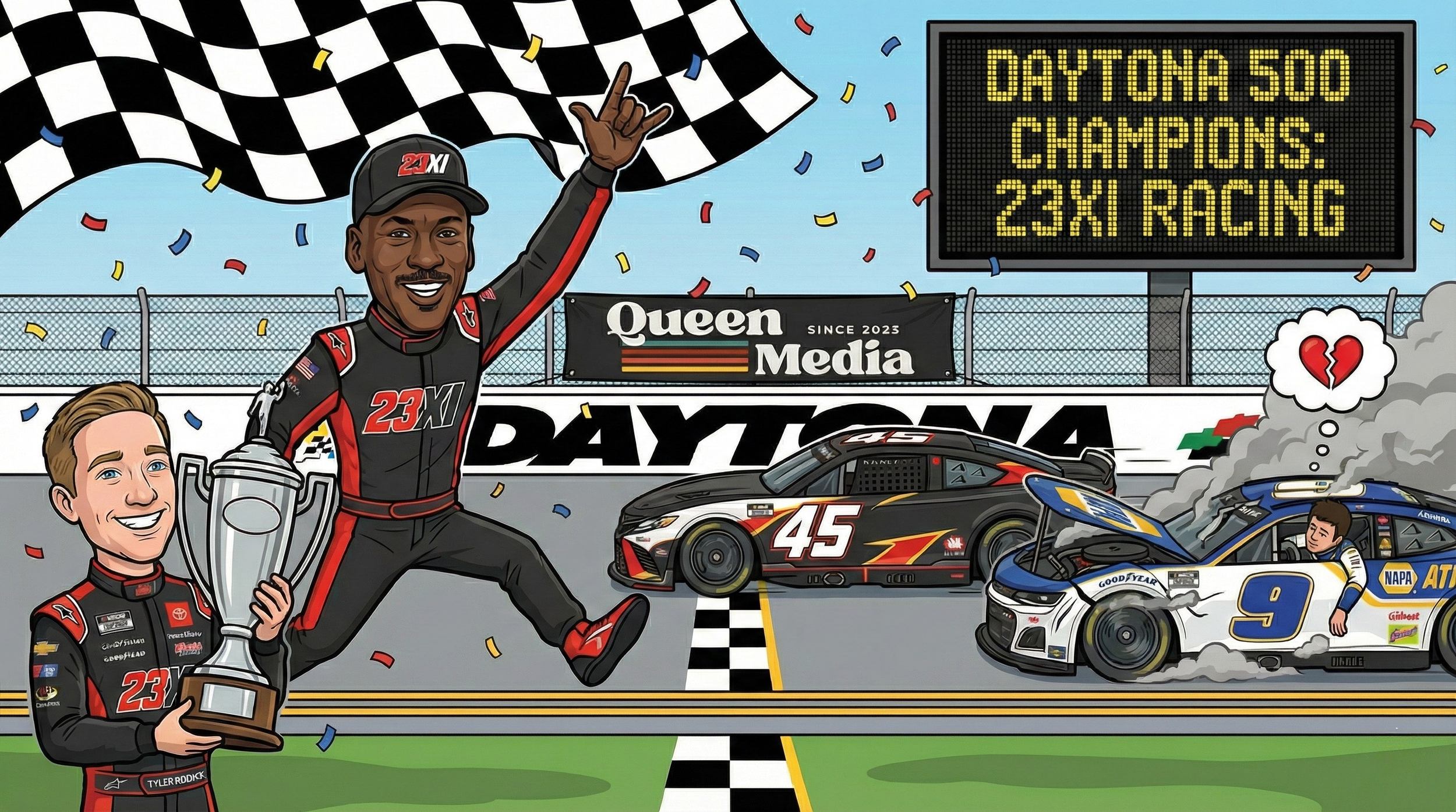
The sound of the Daytona 500 is usually a roar, a deafening, chest-rattling wall of noise that signifies speed and fury. But on Sunday evening, amidst the smoke of burning rubber and the confetti raining down on the tri-oval, the defining sound was not an engine. It was a sigh of relief, followed immediately by a scream of vindication. It came from a luxury suite, then spilled onto the asphalt, as Michael Jordan—NBA legend, global icon, and now, finally, Daytona 500 champion owner—bear-hugged Tyler Reddick in a grip that suggested he might never let go.
For years, Jordan’s venture into NASCAR with 23XI Racing has been viewed with a mix of curiosity and skepticism. Was this a hobby? A branding exercise? Or was the competitive fire that incinerated the NBA in the 1990s truly burning under the hood of those Toyotas? Sunday gave us the definitive answer. This was no hobby. This was a conquest.
Tyler Reddick, the wheelman who delivered the trophy, did it in the most Daytona way possible: by leading only the final 500 yards. It was a chaotic, breath-stealing conclusion to a race that had already frayed the nerves of every spectator in the grandstands. When the white flag waved, it looked for all the world like Chase Elliott’s day. The Hendrick Motorsports star had the lead, the lane, and the momentum. But Daytona is a cruel theater, and the script is never finished until the cars stop moving.
Reddick’s surge on that final lap was a masterclass in timing and trust. He didn’t just drive fast; he drove smart, hooking up with teammate Riley Herbst in a tandem draft that felt almost telepathic. Herbst, whose contribution to this victory cannot be overstated, provided the shove that rocketed Reddick past a helpless Elliott. The move was surgical, executed with the kind of precision that separates the good drivers from the legends. As Reddick crossed the line, 0.308 seconds ahead of a scrambling Ricky Stenhouse Jr., the scoring pylon lit up with the number 45, and the realization washed over the speedway: The kid from California had just given His Airness his biggest ring since 1998.
"I can’t even believe it. It’s surreal," Reddick stammered in Victory Lane, his voice already hoarse. "When you drive for Michael Jordan, it’s expected you win. But this? This is different."
It was different. You could see it in Jordan’s eyes. This is a man who has lifted every trophy that matters in basketball, who has defined excellence for a generation. Yet there he was, giddy as a rookie, hoisting the Harley J. Earl Trophy with a reverence that spoke volumes. "It feels like I won a championship," Jordan admitted, beaming. "It’s so gratifying."
But for every moment of ecstasy at Daytona, there is an equal and opposite moment of agony. Sunday’s heartbreak belonged to Chase Elliott. To be that close, to see the checkered flag in your mind’s eye only to have it snatched away in a cloud of smoke and spinning sheet metal, is a pain unique to this sport. Elliott ended the day fourth, sitting dejected on the pit wall, staring at the ground as the 23XI team celebrated nearby. It was a stark reminder of the thin line between immortality and an "almost" that will haunt you for decades.
The race itself was a slow burn that exploded into a wildfire. For the first 100 laps, the field seemed content to log miles, saving fuel and probing for weaknesses. But as is tradition, the "Big One" was lurking, waiting for a single misstep. It arrived on Lap 124. The trigger was a moment of aggression—or perhaps miscommunication—between Denny Hamlin and Justin Allgaier. A block thrown a fraction of a second too late, a bumper applied a fraction too hard, and suddenly, the track was a scrapyard. Twenty cars were consumed in the melee, including contenders like Ryan Blaney, Kyle Larson, and Bubba Wallace. It was a visceral reminder of the physics at play, metal crumpling like paper at 190 miles per hour.
Yet, from that wreckage emerged the storylines that defined the finish. With so many heavy hitters out or limping, the door opened for the survivors to make their mark. Brad Keselowski, racing with a healing broken femur—a feat of grit that deserves its own column—managed to salvage a top-five finish, proving once again that race car drivers are built differently. Ricky Stenhouse Jr., the 2023 champion, threaded the needle through the last-lap chaos to steal second place, a reminder of his prowess on superspeedways.
But history will only remember the number 45. This win does more than just add a trophy to a case; it validates the entire 23XI experiment. It proves that the team is not just a marketing powerhouse but a technical one, capable of out-dueling the giants of Hendrick and Penske on the sport’s biggest stage. It also offers a sweet redemption for Reddick, who finished second in this race just a year ago. To come back, to endure the pressure, and to deliver in the clutch is the mark of a champion.
As the sun set over Daytona Beach on Sunday night, the party was just getting started. The 2026 Daytona 500 will be remembered for many things: the crashes, the chaos, and the heartbreak. But mostly, it will be remembered as the day the Jumpman logo officially landed in Victory Lane. Michael Jordan has conquered the court, the boardroom, and pop culture. Now, he has conquered the Great American Race. And if Sunday was any indication, he and Tyler Reddick are just getting warmed up. The road to the championship officially goes through the 45 car, and the view from the top is spectacular.
Daytona madness, indeed.
