The Concrete Catalyst: An Exhaustive Analysis of the Eau Gallie Parking Garage, Municipal Finance, and the Redevelopment of the Space Coast

The transformation of the Eau Gallie Arts District (EGAD) in Melbourne, Florida, is a complex redevelopment narrative unfolding on the Space Coast. Once an independent municipality before a 1969 merger with Melbourne, the corridor evolved from a stagnant riverfront into a bustling nexus of commerce and art. At the center of this renaissance is a multi-million-dollar municipal joint-use parking garage integrated with a luxury boutique hotel. This project serves as the linchpin of a strategy designed to alter the district's economic trajectory. Advanced through a Public-Private Partnership (P3) using the Olde Eau Gallie Riverfront Community Redevelopment Agency (CRA), it has ignited regional debate. Proponents argue centralized parking supports growth and elevates the tax base. Critics point to aggressive tax increment captures, environmental impacts on the Indian River Lagoon, and ethical questions regarding municipal leaders and private developers.
The Historical Topography and Economic Genesis of the Eau Gallie Arts District
To understand the controversy surrounding the parking facility, one must examine EGAD's economic mechanics. Following decades of decline, Melbourne established the Olde Eau Gallie Riverfront CRA in 2001 to eliminate "slum and blight" using Tax Increment Financing (TIF). TIF captures additional property tax revenues generated as values rise, sequestering them into a trust fund restricted to reinvestment within the district.
The true inflection point occurred in 2010 with the EGAD Main Street program. Facing a 30 percent commercial vacancy rate, EGAD facilitated over $1.3 million in private and $2 million in public investments. This funded the Eau Gallie Pier reconstruction, streetscaping, and an "Outdoor Museum" featuring over 30 murals. This cultural rebranding was tested by controversial public art in 2018, yet the district now boasts 45 new businesses and 300 new employees. This rapid success strained existing infrastructure, necessitating the garage.
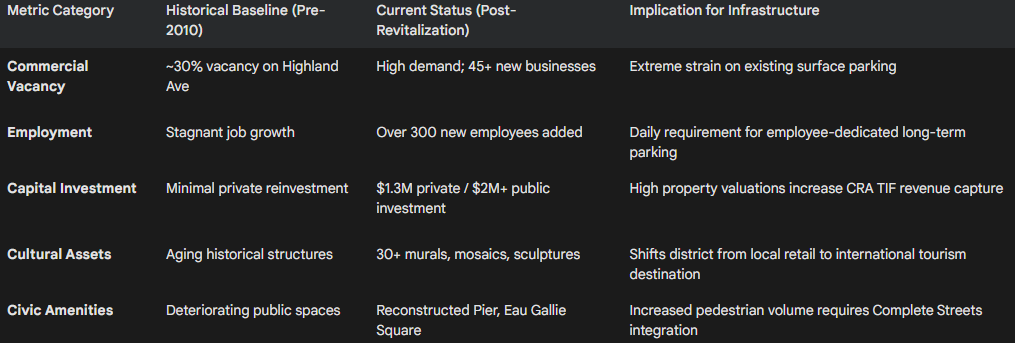
Eau Gallie Arts District (EGAD) Economic and Cultural Revitalization Metrics
The Catalyst Megaproject: The Vision Quest and the Unscripted Hotel
The transformation from a grassroots arts district into a corporate hospitality destination was formalized by the "Vision Quest" master plan in July 2021. The centerpiece is the redevelopment of the Foosaner Art Museum site, slated for demolition to construct the "Unscripted Hotel." Driven by entrepreneur Larry Jarnes and Northboro Builders, this four-star, 160-room luxury boutique hotel operated by the Dream Hotel Group is designed to elevate the district's commercial ceiling.
To integrate this massive structure, the Vision Quest proposed infrastructural realignment, including redeveloping St. Claire Street to divert traffic from U.S. Highway 1. However, the sheer density of the hotel and the permanent loss of existing surface parking presented a logistical impasse. To solve this, Jarnes and Melbourne Hospitality Holdings submitted a P3 Unsolicited Detailed Proposal to build a joint-use parking structure on adjacent municipal land.
The Architecture of Public-Private Partnerships (P3) and Municipal Finance
Situated at 1551 Highland Avenue, the proposed parking garage is the largest single capital expenditure in the district's history. Executing this scale requires sophisticated financing leveraging the statutory powers of the Melbourne City Council acting as the CRA Board. While initial concepts proposed 500 spots, the revised P3 proposal estimated a $10.5 million base construction cost, with ancillary costs pushing the total budget to $12.075 million for 300 spaces.
Funding relies entirely on projecting future tax increments. In its FY 2021-2022 budget, Melbourne indicated the facility would be funded via a "CRA Future Revenue Bond," securing immediate capital while using projected TIF revenues to service debt. Ordinance No. 2021-37 legally authorized the City Council to issue bonds specifically for the garage, stipulating that other redevelopment required Brevard County approval.
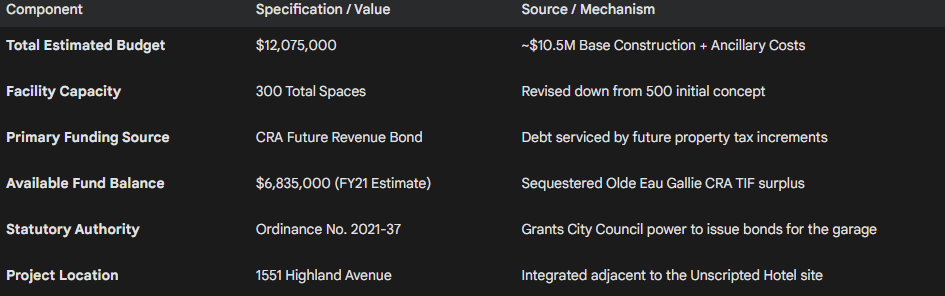
P3 Financial and Operational Structure Matrix
Intergovernmental Warfare: The Brevard County vs. City of Melbourne TIF Battle
Because CRAs capture tax revenues that would otherwise flow into the county's general fund, Brevard County possesses significant oversight. The project could not proceed without Brevard County's approval to amend the Interlocal Agreement dictating TIF capture and the CRA's sunset date.
This tension culminated in a highly debated Brevard County Commission meeting on December 2, 2025. City Manager Jenny Lam presented the city's position, seeking final direction before a December 9 city council hearing. The county mandated stringent minimum requirements to protect its tax base and ensure public access. First, it required a minimum of 270 dedicated public parking spaces, capping the hotel's exclusive spots at 30. Second, the county demanded 15 years of free public parking, followed by 10 years of restricted "maintenance-fee-level" rates. Most critically, the county forced Melbourne to shorten the CRA sunset date by five years to 2033.
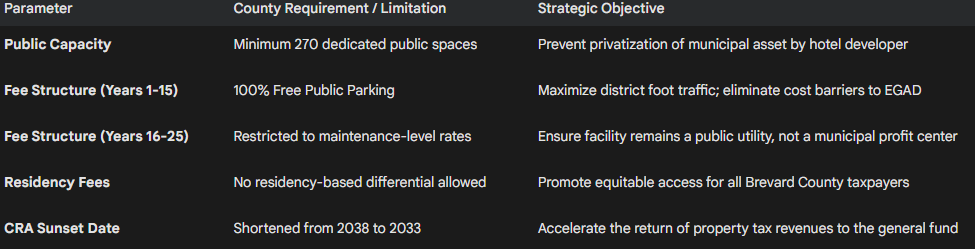
Final Negotiated Parameters of the Eau Gallie Interlocal Agreement (Dec 2025)
Transparency, Ethics, and the Civic Watchdog Movement
The complex financial mechanics of the P3 garage have not shielded it from severe public backlash. As the budget reached $12.075 million, civic activists mobilized to challenge the project's ethical and fiscal foundations. At the core is an ideological debate over municipal priorities. Activists like Sandra Sullivan loudly criticized allocating CRA TIF funds for a localized parking structure while the county faces catastrophic infrastructure failures.
Sullivan contrasted the $12 million spent for a boutique hotel with the pressing needs of the barrier islands and the ongoing ecological collapse of the Indian River Lagoon. Beyond fiscal priorities, the project faced explicit allegations regarding transparency. During public hearings, citizens raised unproven allegations of a potentially inappropriate relationship between Melbourne Mayor Paul Alfrey and developer Larry Jarnes. While documentary evidence of breaches is absent, these allegations highlight an erosion of public trust.
Engineering Resiliency: Green Infrastructure and Environmental Safeguards
Brevard County's unique geography along the fragile Indian River Lagoon (IRL) watershed legally mandates that high-density development address stormwater runoff. During the December 2025 negotiations, the county explicitly required the interlocal agreement to incorporate "reasonable green-infrastructure stormwater design elements."
Traditional concrete parking structures act as thermal sinks and accelerate polluted runoff directly into the lagoon, exacerbating toxic algal blooms. To mitigate this, engineering schematics for the garage and St. Claire streetscape must employ advanced active water-harvesting techniques, catchment basins, and primary rain gardens. Vegetative swales and pervious pavement solutions will slow runoff velocity, allowing the soil to naturally filter pollutants before water enters the estuary. Concurrently, the City of Melbourne authorized massive regional wastewater upgrades, including the total replacement of Lift Station 33 and Lift Station 17 to prevent sewage overflows.
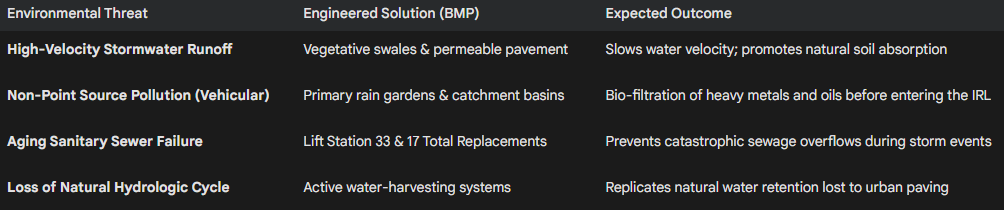
Green Infrastructure and Resiliency Interventions
Regional Traffic Paradigms and the Macro-Development Boom
The garage is part of a synchronized wave of commercial and residential development driven by aerospace expansions and regional migration. A mile away, the Avery Eau Gallie complex will introduce 326 luxury apartments and 500 parking spots, guaranteeing an influx of vehicles into a geographical bottleneck.
Traffic analyses regarding the highly congested U.S. 1 and Eau Gallie Boulevard intersection generated skepticism, prompting the Florida Department of Transportation to initiate intermittent lane closures into Spring 2026 for safety improvements. Meanwhile, the CRA is executing the Pineapple Avenue Complete Streets Project to encourage pedestrian transit. Interestingly, Melbourne faces a different parking paradigm downtown, where the city is implementing stringent punitive enforcement and paid parking meters to stimulate turnover, directly contrasting the county-mandated 15 years of free parking in Eau Gallie.
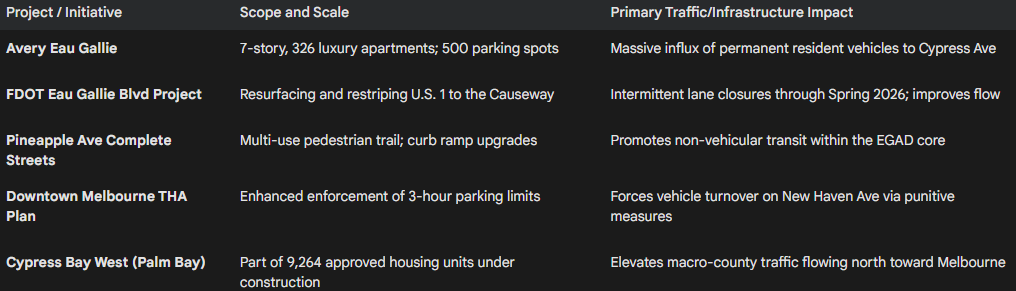
Concurrent Regional Development and Traffic Impacts
Socio-Cultural Impacts and the Space Coast Community Fabric
Infrastructure shapes the socio-cultural life of a community. For hyper-local media like Queen Media—whose studio sits just around the corner from the Eau Gallie Arts District and a mere two blocks from Eau Gallie Boulevard—chronicling Brevard County requires examining how the parking garage alters local interactions on the ground. The reality of this explosive growth is undeniable to those who live and work here. Just last week, a trip to grab food at Pineapples turned into a testament to EGAD's booming popularity: parking was nowhere to be found because the area was completely full of people. For locals who grew up in Eau Gallie, watching the district evolve and thrive to what it is today is a beautiful thing to witness, even if it means circling the block a few extra times.
These logistical realities of Eau Gallie Boulevard directly impact everything from a casual dinner out to high school athletics, such as the annual football rivalry between the Melbourne Bulldogs and the Eau Gallie Commodores, which draws thousands and demands efficient infrastructure. Furthermore, local commercial advocates view the garage as an essential enabler for community events. The Eau Gallie Rotary Club and local organizers depend on accessible parking for large-scale gatherings like the Cookie Crawl and Brewfests at Eau Gallie Square. The garage is viewed as necessary infrastructure to prevent these cultural staples from collapsing under their own weight.
Conclusion
The Eau Gallie Parking Garage is the physical manifestation of the Space Coast's struggle to balance economic expansion with civic accountability and environmental stewardship. Through the Olde Eau Gallie Riverfront CRA, Melbourne leveraged its future property tax base to underwrite infrastructure supporting the Unscripted Hotel. This P3 illustrates the immense power and socio-political risks of Tax Increment Financing.
While TIF eliminates commercial blight, it sequesters millions from county-wide infrastructure pools. The December 2025 negotiations successfully established vital guardrails—capping the CRA sunset at 2033, mandating 270 public spaces, enforcing a free-parking epoch, and demanding green stormwater infrastructure—democratizing an asset that risked privatization. However, political friction, outrage over funding priorities, and ethical allegations underscore public fatigue with opaque municipal financing. As construction targets 2026 alongside parallel megaprojects, the district's carrying capacity will be tested. Ultimately, if the green infrastructure performs as engineered and the hotel drives projected revenues, the garage will be validated as a triumph of municipal engineering.
