Queen Media News Special Report: Daring Iran Rescue Mission
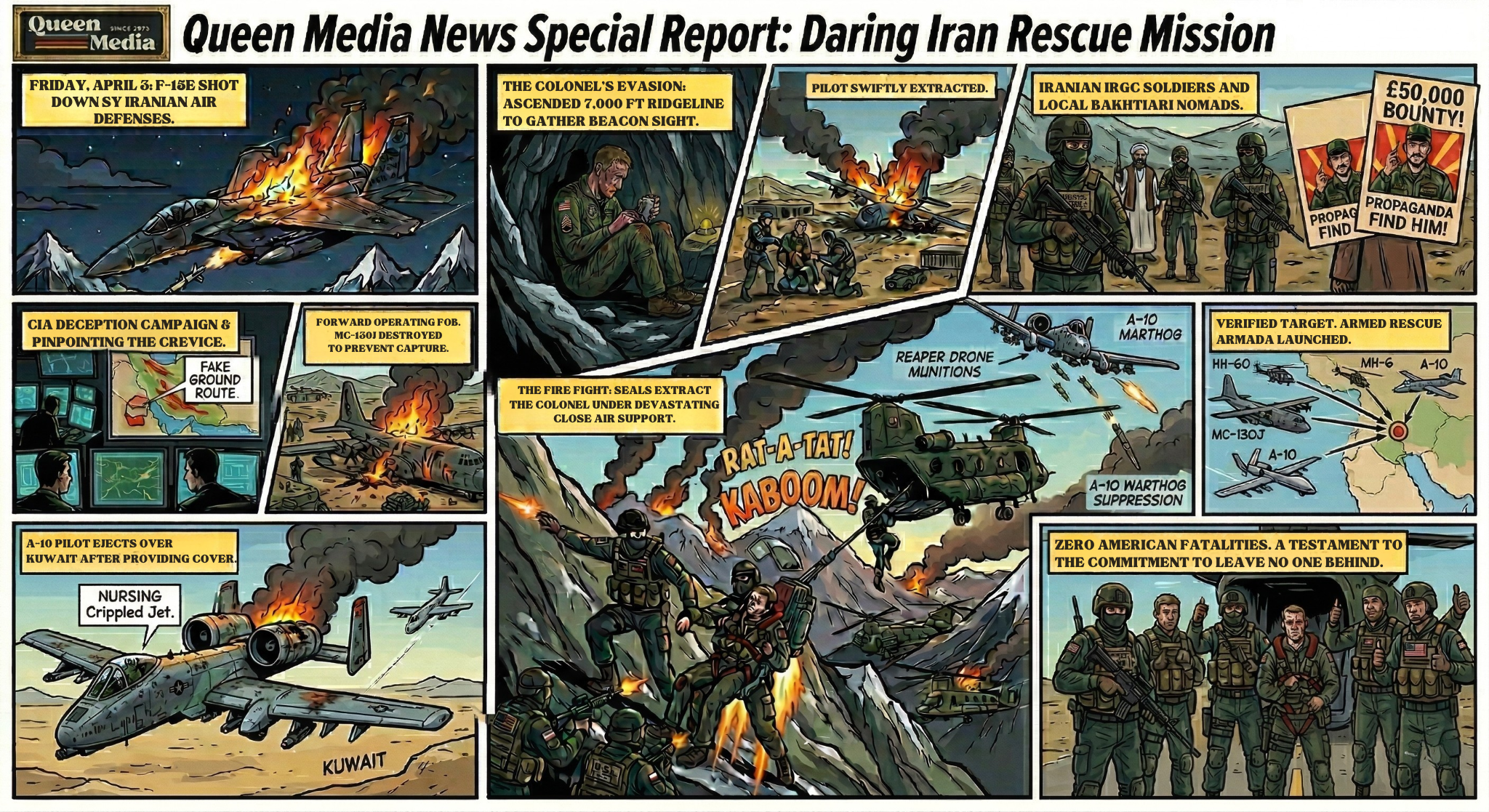
In the early, predawn hours of Sunday, April 5, 2026, the world received confirmation of a miraculous military extraction deep within the hostile, mountainous terrain of southwestern Iran. A stranded American aviator—a weapons systems officer (WSO) holding the rank of Colonel—was pulled from the treacherous Zagros Mountains after being relentlessly hunted by enemy forces for nearly forty-eight hours. This daring mission dominated international headlines as a major victory for the United States during the ongoing Operation Epic Fury.
The Shootdown and the Evasion Dragnet
The harrowing ordeal commenced late Friday, April 3, during a complex nighttime strike mission over Iranian airspace. A two-seat F-15E Strike Eagle, identified as belonging to the 48th Fighter Wing's 494th Fighter Squadron, was engaged and ultimately shot down by Iranian integrated air defenses. While the pilot of the aircraft was swiftly located and extracted by American forces within hours of the crash, the Colonel acting as the WSO was separated in the descent, initiating a massive, high-stakes evasion scenario behind enemy lines.
Armed with nothing more than a standard-issue military sidearm and survival instincts honed by years of rigorous training, the injured aviator was forced to navigate the unforgiving topography of the Kohgiluyeh and Boyer-Ahmad province. Seeking a tactical advantage and a viable line of sight for his emergency communication beacons, the Colonel ascended a brutal seven-thousand-foot ridgeline before taking refuge in a deep mountain crevice.
The adversary response was sweeping and ruthless. The Islamic Revolutionary Guard Corps (IRGC), bolstered by local Basij militia units, initiated a sweeping dragnet of the region. Recognizing the immense propaganda value of capturing a senior United States aviator, Iranian authorities incentivized the civilian populace, placing a lucrative fifty-thousand-pound bounty on the Colonel's head and urging local Bakhtiari nomadic tribesmen to assist in the manhunt.
Interagency Deception and Tactical Firepower
The extraction was not merely a feat of physical bravery; it was a masterpiece of interagency coordination and psychological warfare. As Iranian forces closed in on the Zagros mountains, the Central Intelligence Agency (CIA) launched a brilliant informational deception campaign. Intelligence operatives systematically fed false data into Iranian military networks, suggesting that the U.S. had already located the airman and was actively moving him via a ground exfiltration route toward a neighboring border. This calculated disinformation fractured the Iranian search matrix, causing regional commanders to divert vital search assets away from the Colonel's actual location. Simultaneously, the CIA utilized highly classified capabilities to pinpoint the airman's exact crevice, relaying real-time geospatial coordinates directly to the White House and the Pentagon.
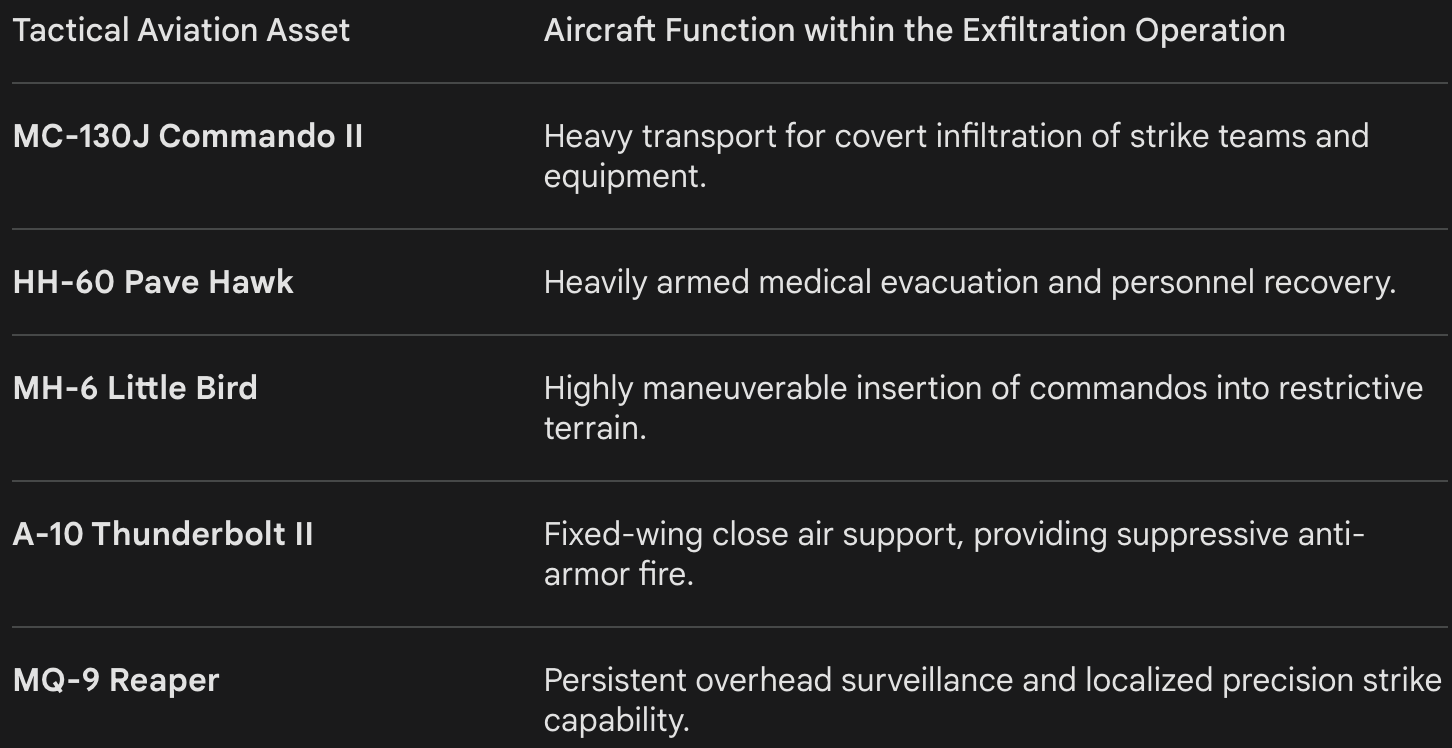
With the target verified, the physical rescue armada was launched. The operation featured a complex integration of elite tier-one commandos and specialized rescue assets.
To sustain this massive air armada, U.S. commandos audaciously secured an abandoned agricultural airstrip in southern Isfahan province, utilizing it as a temporary forward operating base. The tactical friction of operating deep behind enemy lines was immediate and severe. Two highly modified MC-130J Commando II transport planes suffered critical mechanical malfunctions on the dirt airstrip. Adhering to strict technology-denial protocols, U.S. forces deliberately destroyed the compromised airframes with explosives to prevent Iranian intelligence from capturing and reverse-engineering their advanced avionics.
The Extraction Firefight
Despite the loss of the heavy transports, the ground assault team pushed forward. SEAL Team Six commandos approached the mountain crevice just as the CIA's deception campaign began to lose its fog, allowing Iranian IRGC units to converge on the true extraction zone.
A heavy, chaotic firefight erupted on the mountainside. To protect the exposed rescue teams, A-10 Warthogs and MQ-9 Reaper drones provided devastating close air support, dropping precision-guided munitions directly onto the advancing Iranian convoys to create an impenetrable defensive corridor. The airspace was choked with heavy anti-aircraft fire; two American rescue helicopters sustained direct battle damage but remained miraculously flyable. One A-10 Warthog, providing critical covering fire for the rescue forces, was hit so severely that its pilot was forced to nurse the crippled jet out of Iranian airspace, eventually ejecting safely over Kuwait before the aircraft crashed.
Amidst this overwhelming exchange of firepower, Navy SEALs successfully reached the Colonel. Operating under fire, they stabilized his serious injuries, loaded him onto an extraction platform, and rapidly transported him out of the hostile territory.
Against astronomical odds, the United States military executed one of the most complex and lethal search and rescue operations in its history without suffering a single American fatality. The successful recovery of the downed F-15E Weapons Systems Officer stands as a testament to the nation's unwavering commitment to its warfighters, ensuring that no American is ever left behind.
