Artemis II Delays: The Space Coast’s Proudest, Most Exhausting, and Traffic-Inducing Burden
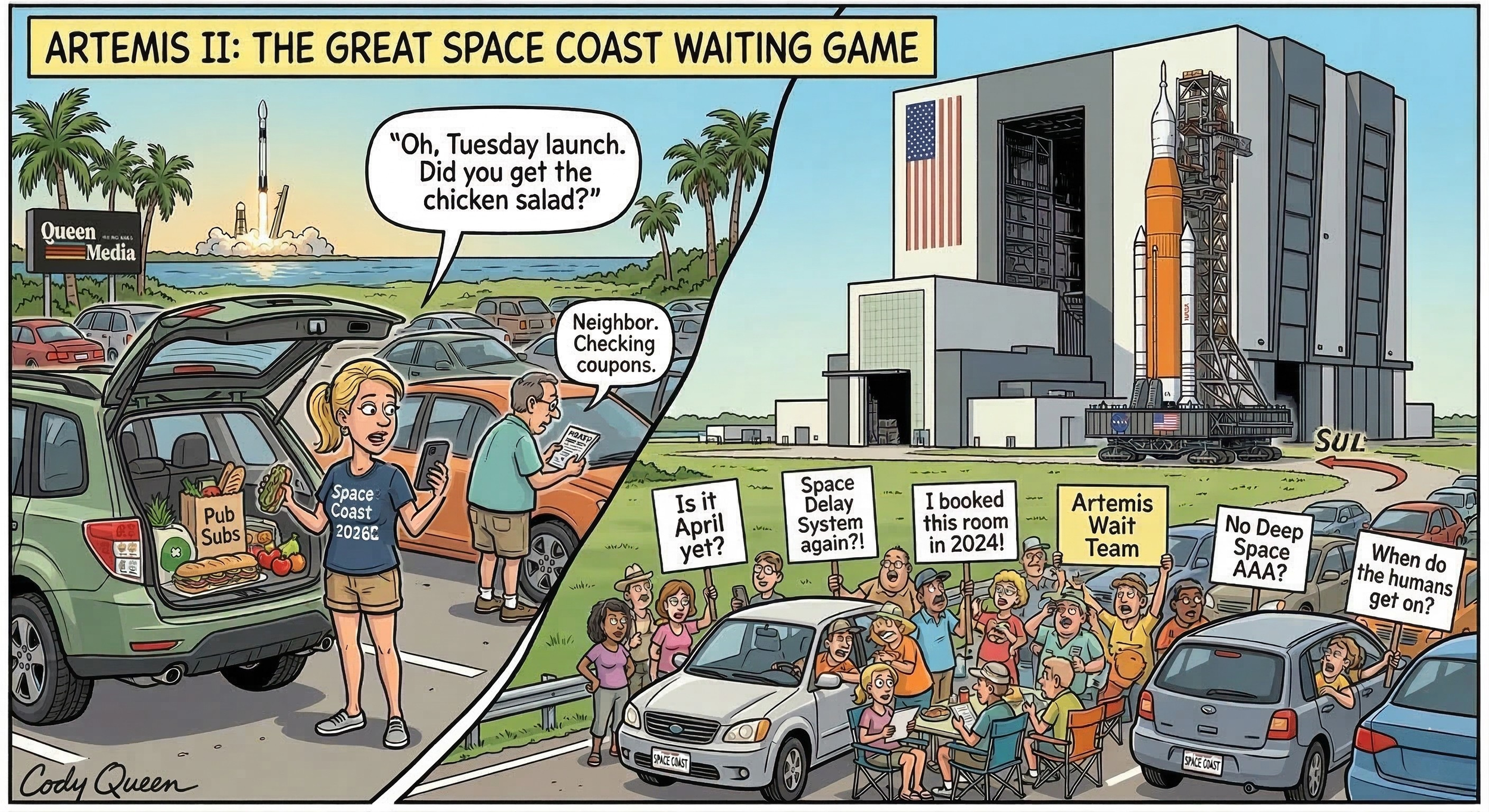
If you live on the Space Coast in 2026, you’ve likely developed a highly specific superpower: the ability to completely ignore a rocket launch while loading groceries into your trunk. With a launch cadence that basically mirrors the local bus schedule, a Falcon 9 rattling the windows along A1A barely registers anymore. “Oh, the sky is on fire? Must be Tuesday. Did you remember the Pub Subs?”
But the behemoth currently sitting in the Vehicle Assembly Building (VAB) is a different beast entirely.
The Space Launch System (SLS) rocket for the Artemis II mission is humanity’s multi-billion-dollar ticket back to the Moon. It will carry humans beyond low Earth orbit for the first time since the Apollo days of 1972. Yet, as the calendar inches closer to a highly anticipated (and highly theoretical) April launch window, the mood in Brevard County is a complicated cocktail: one part soaring historical pride, two parts logistical dread, and a heavy splash of "please just launch already."
The Universe's Slowest U-Turn
Let’s be honest: the road to Artemis II has been less of a victory lap and more of a bumpy ride in a golf cart with a bad axle.
The world expected to see astronauts Reid Wiseman, Victor Glover, Christina Koch, and Jeremy Hansen strap into the Orion capsule months ago. I wouldn't blame the crew if they’ve started wearing their spacesuits around the house just to feel like things are moving. Instead, the local news cycle has been dominated by plumbing issues and shifting timelines.
First came the meticulous evaluations of the ablative heat shield. Then, during the wet dress rehearsals, a liquid hydrogen leak triggered stressful flashbacks for anyone old enough to remember the Space Shuttle era's temperamental plumbing. And just when ground teams seemed to have the fueling process wrangled, a helium flow issue in the upper stage reared its head late last month.
The result? The agonizingly slow, multi-hour crawl of the crawler-transporter hauling the massive SLS rocket off Launch Complex 39B and back into the VAB. It was, effectively, the most expensive and slowest U-turn in human history.
It is incredibly easy for the armchair engineers on social media to get cynical, dusting off the classic "Space Delay System" jokes. But the reality of spaceflight is ruthlessly unforgiving. When you are preparing to strap four actual human beings to a skyscraper filled with explosives and throw them at the Moon, you do not gamble. You don't ignore a helium leak just because the tourists have already booked their Airbnbs. NASA’s decision to roll back is a frustrating delay, but from a survival standpoint, it is the only correct choice.
Deep Space Doesn't Have AAA
The life-or-death stakes of this mission were put into sharp, somewhat terrifying perspective recently by a NASA Office of Inspector General (OIG) report. The assessment highlighted several critical gaps in the agency’s approach to risk management, pointing out one very glaring reality: NASA currently lacks the capability to rescue a stranded crew if a catastrophic emergency occurs in deep space.
Basically, there is no intergalactic tow-truck. If things go wrong, they go wrong in a very permanent way.
This is the unfiltered reality of deep space exploration. It is inherently, unfathomably dangerous. NASA leadership faces the impossible task of balancing the geopolitical pressure of a new lunar space race against the absolute moral imperative to not lose their crew. Because of this, the upcoming Flight Readiness Review update scheduled for tomorrow, Thursday, March 12, will be one of the most closely watched briefings in recent memory. We’re all waiting to see if that April window will actually hold, or if we need to extend our lease on the waiting game.
The Great Brevard Traffic Jam of 2026
Down here on the ground, the delays just extend an agonizing—yet economically thrilling—purgatory. The Space Coast isn't just watching history; we are bracing for impact.
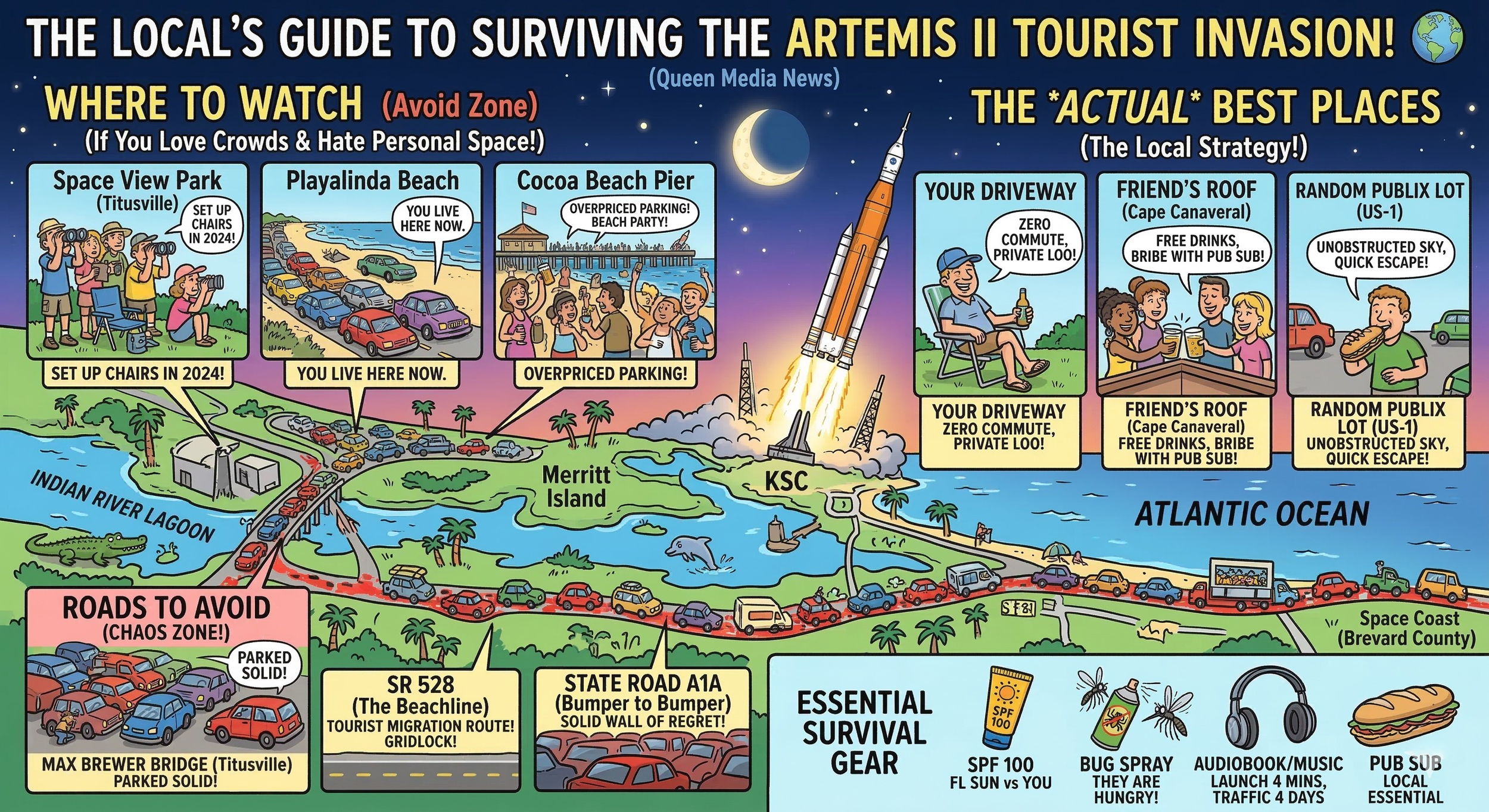
When Artemis I launched in the middle of the night back in 2022, the causeways were parked solid. Artemis II, featuring a diverse human crew and a massive media hype train, is going to multiply that crowd exponentially. Local businesses are hoarding inventory, hotel rates require a second mortgage, and local law enforcement is finalizing traffic management plans that resemble the D-Day invasion, just with more folding chairs, sunscreen, and inevitable road rage on US-1.
Sure, the economic boom is great. But beyond the tourism dollars, there is a profound sense of local ownership. The people turning the wrenches, analyzing the data, and guarding the gates are our neighbors. They coach Little League in Titusville, they sit in the same awful traffic in Viera, and they surf in Cocoa Beach. When Artemis II finally clears the tower, the roar of the engines will be matched only by the collective sigh of relief from the locals who built it.
Silicon Valley with Alligators
What makes this holding pattern so fascinating is the backdrop. Right down the road from the VAB, the commercial space sector is absolutely flexing. SpaceX is actively shuffling massive Starship hardware around, occasionally turning our local roads into their personal driveway. Blue Origin’s colossal manufacturing facilities are gobbling up Exploration Park.
The Space Coast has transformed into the Silicon Valley of spaceflight, just with vastly more humidity and the occasional alligator on the runway. NASA is no longer the only game in town, but with Artemis, they are reminding everyone who built the stadium. The grand plan is for future Artemis missions to use commercial landers from SpaceX and Blue Origin anyway, meaning this whole public-private ecosystem relies entirely on getting Artemis II safely around the Moon to prove it all works.
The Final (Eventual) Countdown
So, the Space Coast waits. We wait for the engineers to give the green light. We wait for tomorrow’s press conference. And we wait for the crawler to make its triumphant, one-mile-per-hour journey back to Pad 39B.
The delays are a masterclass in testing our patience, but they are also a stark reminder of the absolute audacity of going to the Moon. It isn’t easy. But when the sky over Merritt Island finally lights up with a false sunrise, and that chest-rattling rumble rolls across the Indian River Lagoon, every delay, every rollback, and every tourist cutting you off in traffic will be forgiven.
Humanity is about to make history again. And there is nowhere on Earth better to watch it unfold—traffic jams and all—than right here on the Space Coast.
