The Ghost of Dragon Point: Why We Still Look North on the Causeway
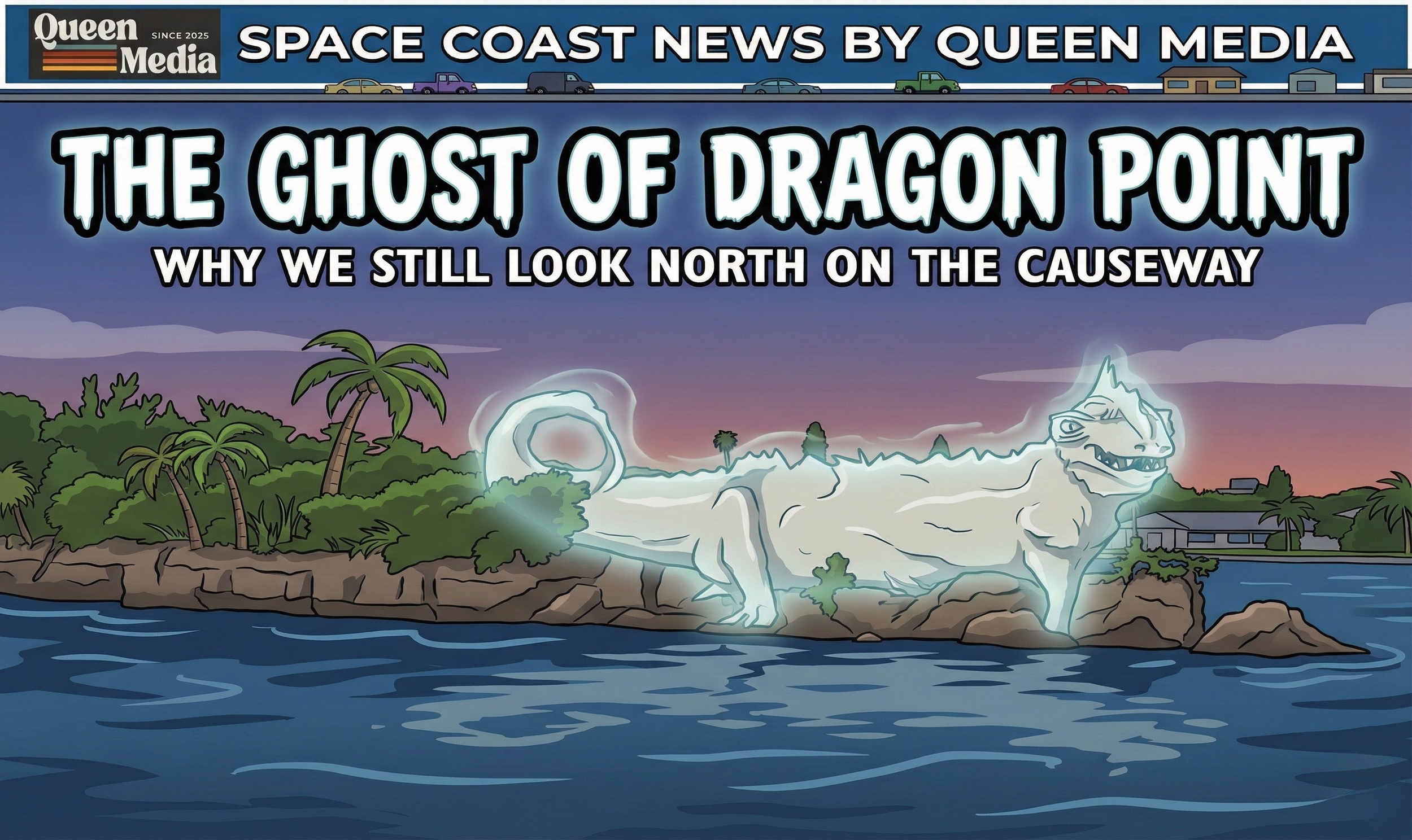
In the unique geography of memory that defines the Space Coast, there are landmarks you navigate by, and then there are landmarks you live by. For thirty-one years, the psychological center of Brevard County wasn't the Vehicle Assembly Building or the launch pads of Cape Canaveral. It was a green, sixty-five-foot-long ferrocement monster perched at the southern tip of Merritt Island.
If you drove the Eau Gallie Causeway anytime between the final Apollo missions and the early years of the War on Terror, you know the ritual. You would crest the concrete hump of the bridge, the Indian River Lagoon stretching out like a sheet of hammered tin to your left and the Banana River opening up to your right. But your eyes wouldn't linger on the water. Inevitably, magnetically, every head in the car turned north. We were checking on Annie.
To the uninitiated, she was a roadside attraction gone rogue—a private folly commissioned by Aynn and Jeff Christal in 1971. But to those of us who grew up in her shadow, the Merritt Island Dragon was the genius loci, the protective spirit of the place. She stood at the hydrodynamic singularity where two great estuaries collide, a gatekeeper guarding the mixing bowl of currents that defined our local ecology.
The story of her creation is the story of a vanished Florida. She wasn't built by a corporate engineering firm or stamped out of a mold. She was birthed from the eccentric imagination of Lewis VanDercar, a Miami artist who styled himself a "warlock" and the "Magus Supreme." In an era when our neighbors were using slide rules to calculate trajectories to the moon, VanDercar was using wheelbarrows to haul twenty tons of concrete and steel down a narrow boardwalk. He built Annie by hand, troweling mortar over a skeleton of steel rods, crafting a creature that was part Salvador Dalí and part storybook guardian.
That contrast defined our identity. The Space Coast was a landscape of high-tech rationality, a place of clean lines, right angles, and orbital mechanics. Annie was the counterweight. She was the necessary injection of whimsy and magic into a world of engineers. She reminded us that despite our rockets, we were still creatures drawn to myths and monsters.
And what a monster she was. She wasn't just a statue; she was a habitable experience. Her belly was a hollow room, a playhouse adorned with hieroglyphics painted by her warlock creator. A spiral staircase wound up through the interior of her neck, allowing the brave to climb up and look out through her eyes—a literal dragon’s-eye view of the lagoon.
For the boating community, she was more than art; she was a navigational constant. "Turn at the Dragon" was the only direction that mattered on the Intracoastal. On weekends, the water around Dragon Point became a floating social club. Fishermen swore the waters around her submerged tail were blessed, holding the biggest redfish and snook in the county. Teenagers whispered legends about sneaking onto the property at night to drink beer in the dragon’s stomach, a rite of passage that separated the tourists from the locals. And on the Fourth of July, she lived up to her name. A propane system rigged in her throat allowed her to belch fire into the humid night sky, a primal display that drew cheers from the armada of boats anchored below.
But ferrocement is mortal, and the salt air of the lagoon is relentless. The end came in August 2002, aided by the corrosion of steel and the malice of vandals who had weakened her structure with sledgehammers. During a summer storm, her majestic neck snapped. The head that had watched over us for a generation plunged into the dark water.
The years that followed were a period of mourning. The headless ruin on the point was a jagged scar on the landscape, a daily reminder that the whimsical, "Old Florida" was crumbling away, replaced by the sterilized efficiency of modern development. We tried not to look when we crossed the bridge, but the phantom limb sensation was too strong.
Now, as we move through 2026, the saga of Dragon Point has entered a new, complex phase. The land has been cleared, the ruins removed. The property is currently listed for millions, marketed as a "world-class waterfront estate" with views of rocket launches. The developer, Don Facciobene, has proposed a successor: Rojak, a two-headed dragon designed to watch over both rivers.
Yet, the listing suggests Rojak is now a negotiable amenity, an option for the next billionaire owner rather than a guarantee for the public. The dragon has transitioned from a labor of love to a line item in a real estate portfolio.
It remains to be seen if Rojak will ever rise, or if the point will become just another manicured lawn behind a gate. But for those of us who remember the smell of the river and the flash of fire in the night, the concrete reality matters less than the memory. The dragon proved that we crave mythology. We need to believe that there is magic in the water. So, even today, when the traffic slows on the Eau Gallie Causeway, we still look north. We look for the monster in the mist, the sentinel that told us we were home.
