The Rock and the River: A Monograph on the History, Ecology, and Urban Evolution of Eau Gallie, Florida
The Persistence of Place
In the sprawling, often homogenized landscape of Florida’s Space Coast, the district of Eau Gallie stands as a distinct anomaly. Technically merged into the City of Melbourne in 1969, Eau Gallie has refused to dissolve its identity into the municipal whole. Instead, it has persisted—first as a fiercely independent frontier town, then as a neglected historic quarter, and now, in the mid-2020s, as the region’s premier "Arts District." This report provides an exhaustive analysis of Eau Gallie, tracing its trajectory from a geological curiosity known for its "rocky water" to a complex urban case study grappling with the forces of gentrification, ecological stewardship, and cultural reinvention.
The narrative of Eau Gallie is not merely one of local history; it is a microcosm of the broader Florida experience. It encompasses the boom-and-bust cycles of the late 19th century, the transformative power of the Henry Flagler railroad, the post-war explosion driven by the space race, and the contemporary struggle to balance heritage preservation with the demands of high-end development. Through a synthesis of historical records, ecological data, and current urban planning initiatives, this document explores how a settlement founded on a coquina ridge overlooking the Indian River Lagoon has managed to retain its soul through a century and a half of relentless change.
2. Geology and Ecology of the Indian River Lagoon
To understand the human settlement of Eau Gallie, one must first interrogate the landscape. The community’s location is not accidental; it is a direct consequence of specific geological and hydrological features that distinguished it from the surrounding coastline.
2.1 The Hydrology of the "Rocky Water"
The name "Eau Gallie" serves as the primary linguistic artifact of the town’s geological identity. While the exact etymology has been a subject of local debate—oscillating between French and indigenous roots—the consensus settles on a description of the physical landscape. The term is widely accepted to translate as "rocky water," derived from the French eau (water) and a second term, likely galet (pebble).1 This refers to the coquina rock formations that line the shore of the Indian River Lagoon in this specific location.3
Coquina, a sedimentary rock composed of consolidated shells and sand, is relatively rare on the central Florida mainland coast. Its presence provided early settlers with two critical assets: a solid foundation for construction in a region often dominated by shifting sands and swamplands, and a raw material for building. The geological uniqueness of the Eau Gallie bank created a natural harbor, where the freshwater Eau Gallie River empties into the brackish lagoon, offering a sheltered anchorage that would eventually attract the area’s first permanent residents.4
2.2 The Estuarine Engine: The Indian River Lagoon System
Eau Gallie exists in a symbiotic relationship with the Indian River Lagoon (IRL). Despite its name, the IRL is not a river but a bar-built estuary—a semi-enclosed body of water where saltwater from the Atlantic Ocean mixes with freshwater runoff from the Florida peninsula.5 This mixing creates a brackish environment of extraordinary biological productivity.
The lagoon system spans 156 miles across five counties, with Eau Gallie situated at a critical narrowing point. The lagoon’s biodiversity is staggering, hosting more than 4,000 species of plants and animals.6 This biological richness drove the early economy of the settlement, which relied heavily on commercial fishing and subsistence harvesting.
Table 1: Biological Diversity of the Indian River Lagoon Ecosystem
Taxonomic GroupEstimated Species CountEcological SignificanceIchthyofauna (Fish)685
Includes commercially vital species like Spotted Seatrout, Red Drum, and Common Snook. The lagoon acts as a nursery for oceanic species.5
Avifauna (Birds)370
High concentrations of wading birds (Roseate Spoonbill, White Ibis) and raptors (Osprey) which use the mangroves for nesting.5
Flora (Plants)2,100
Includes critical seagrass meadows (7 species) and mangrove forests (Red, Black, White) that stabilize shorelines and sequester carbon.5
MammaliaN/A
Key habitat for the West Indian Manatee and Atlantic Bottlenose Dolphin. The lagoon supports nearly 1/3 of the nation’s manatee population seasonally.9
The health of the Eau Gallie waterfront is intrinsically tied to the health of this ecosystem. In recent decades, the lagoon has suffered from "inadvertent, undesirable changes" caused by human activity, including septic tank leakage and fertilizer runoff.10 These nutrient inputs trigger algal blooms that block sunlight, killing the seagrass beds that serve as the foundation of the food web. The loss of seagrass has led to mass mortality events for manatees, a crisis that has mobilized local environmental groups and revitalized interest in the lagoon’s stewardship.9
2.3 The Eau Gallie Causeway: Connectivity and Viewshed
The connection between mainland Eau Gallie and the barrier island (now Indian Harbour Beach) has historically been a defining feature of the town’s geography. The Indian River Lagoon is approximately two miles wide at this point, necessitating substantial engineering to bridge.
The 1926 Wooden Bridge: The first vehicular link opened on February 22, 1926 (Washington’s Birthday). It was a rudimentary wooden structure connecting to a sand trail on the beach side. The bridge was notoriously dangerous, lacking railings for its first year and prone to catching fire due to the arid climate and wooden construction. Historical records note a period where 16 bridge fires occurred in 14 nights, leading to the resignation of the exhausted fire chief.3
The 1955 Concrete Bridge: Dedicated to Dr. William Jackson Creel, a pioneering physician in the area, this structure featured a swing-span drawbridge, reflecting the continued importance of boat traffic on the Intracoastal Waterway.11
The 1988 High-Rise Causeway: The current structure (SR 518) is a fixed-span high-rise bridge. While utilitarian in purpose (hurricane evacuation and commuting), it serves as a primary vantage point for the district. From the apex of the causeway, one can view the "Dragon’s Point" (the southern tip of Merritt Island) and the expanse of the lagoon, providing a visual context for Eau Gallie’s orientation toward the water.11
3. The Pioneer Era: Foundations of a Frontier Town (1850s–1900)
The transformation of Eau Gallie from a geological feature to a human settlement was driven by two distinct waves of migration: the agricultural pragmatists and the political visionaries.
3.1 The Houston Dynasty and "Arlington"
The first permanent American settler in the area was John Carroll Houston IV, who arrived in 1859. Houston did not initially choose the name Eau Gallie; he called his homestead "Arlington." The Houston family established the agrarian baseline for the community, cultivating sugar cane, rice, and vegetables in the fertile, if difficult, soil. Their economic existence was one of barter and extraction; they traded otter skins and alligator hides for manufactured goods like coffee and sugar.12
The Houston homestead was strategically located near the river, utilizing the natural resources for survival. They built their own skiffs and employed primitive fishing techniques—burning torches in buckets of sand to attract fish into their boats at night.13 The Houston legacy is physically embedded in the town’s modern landscape; the site of their original slave quarters and later homestead eventually became the foundation for the Rossetter House, linking the pioneer era directly to the merchant era that followed.14
3.2 William Henry Gleason and the Political Origin of "Eau Gallie"
If Houston provided the agricultural root, William Henry Gleason provided the political ambition. A former Lieutenant Governor of Florida, Gleason was a figure of significant influence during the Reconstruction era. In 1860, while traveling the coast, he was struck by the beauty of the harbor and the coquina ridges. He capitalized on the availability of cheap federal land, purchasing a staggering 16,000 acres—approximately 30 square miles—at the government price of $1.25 per acre.2
Gleason is the architect of the name "Eau Gallie." His vision for the settlement was grandiose. He platted the land and envisioned a major metropolis that would span from the Indian River to Lake Washington. It was Gleason who sought to leverage the coquina rock not just for aesthetics but for institutional permanence.3
3.3 The Phantom Agricultural College
The most significant "what if" in Eau Gallie’s history occurred in the 1870s. Gleason, utilizing his political connections, offered 2,320 acres of his Eau Gallie holdings to the State of Florida for the establishment of the state’s agricultural college. The legislature accepted the offer, and construction began on a main building constructed of the native coquina rock.3
Had this project succeeded, Eau Gallie would likely have become the home of what is now the University of Florida. However, the volatile political climate of the 1870s—specifically the shift in power in Tallahassee—doomed the project. In 1877, the state legislature relocated the college site to Lake City, abandoning the Eau Gallie campus. Gleason, ever the opportunist, repurchased the unfinished coquina building and repurposed it into the Granada Hotel, effectively pivoting the town’s future from academia to tourism.3
3.4 The Arrival of the Iron Horse
For the first few decades of its existence, Eau Gallie was accessible primarily by water. Steamboats plying the Indian River were the lifeline for mail, supplies, and passengers. The arrival of Henry Flagler’s Florida East Coast Railway (FEC) in 1893 shattered this isolation. The railroad brought reliable, rapid transport for the region's citrus crops and fish, and crucially, it brought Northern tourists. While the railroad eventually eased the steamboats out of business, the transition was gradual, and the river remained a central artery of life well into the 20th century.3
4. The Independent City: Economic & Social Maturation (1900–1969)
For the first two-thirds of the 20th century, Eau Gallie operated as a sovereign municipality, distinct from Melbourne to the south. This era was defined by the rise of a merchant class, the development of civic institutions, and the slow but steady urbanization of the pine flatwoods.
4.1 The Rossetter Era and the Merchant Class
The arrival of James Wadsworth Rossetter in 1902 signaled a shift from pioneer survivalism to established commerce. The Rossetters were a prominent Florida family with business interests ranging from Jacksonville to the Keys. James Rossetter purchased the former Houston property and constructed the home that stands today as the Rossetter House Museum.14
James Rossetter became a central economic figure, operating as a primary agent for the Standard Oil Company and a leader in the commercial fishing industry. Upon his death in 1921, the management of these enterprises fell to his daughter, Caroline "Carrie" P. Rossetter. In an era when female business leadership was rare, Carrie Rossetter not only maintained the family fortune but expanded it, steering the Standard Oil agency through the boom of the 1920s and the bust of the Great Depression. Her stewardship ensured the preservation of the family estate, which now serves as the historical anchor of the district.14
4.2 Infrastructure of a City
As an independent city, Eau Gallie developed a complete suite of civic infrastructure:
Education: The Eau Gallie High School was established in 1924, a significant milestone that allowed local children to be educated within the community rather than traveling to Melbourne or Titusville. This building later transitioned into Dr. W.J. Creel Elementary.12
The Library: The Eau Gallie Public Library has a lineage dating back to 1898, making it the second oldest in the county. It migrated through various temporary homes—including the post office and a restaurant—before settling in its current riverfront location in Pineapple Park in 1962 (rebuilt in 1998).15
Hospitality: The Granada Hotel was joined by the Harbor City Hotel in 1926. Situated near the new bridge, the Harbor City Hotel (later the Oleanders and the Imperial) was a 51-room Spanish-style edifice that catered to the land-boom tourists. Its construction symbolized Eau Gallie’s aspiration to be a resort destination on par with Palm Beach or Miami.3
4.3 The Post-War Boom and the Space Race
The quiet river town changed forever with the advent of World War II and the subsequent Cold War. The establishment of the Naval Air Station in Melbourne and the explosion of activity at the Cape Canaveral missile test range (later NASA) created an insatiable demand for housing. Eau Gallie, with its abundance of developable land (thanks to Gleason’s original massive purchase), became a bedroom community for the engineers and technicians of the space program.4
Population growth necessitated modern utilities—water, sewer, and roads—which strained the resources of the small municipality. This pressure set the stage for the political conflicts of the late 1960s.
5. The Merger: 1969 and the Crisis of Identity
The year 1969 is the single most traumatic date in Eau Gallie’s history. It represents the moment the city ceased to exist on paper, sparking a struggle for identity that continues more than half a century later.
5.1 The Consolidation Vote
By the late 1960s, the logic of consolidation was driven by the technocratic demands of the Space Coast boom. Planners argued that maintaining two separate police forces, fire departments, and water systems for Eau Gallie and Melbourne was inefficient. A referendum was held, and the residents voted to merge the two cities.4
The contention arose not from the merger itself, but from the naming of the new entity. A subsequent vote was held to determine the name of the consolidated city. "Melbourne" won, largely due to its higher population and perhaps better name recognition outside the region. Overnight, the City of Eau Gallie became merely the "Eau Gallie section" of Melbourne.18
5.2 The Lingering Divide
The erasure of the name did not erase the community’s sense of self. For decades, long-time residents continued to refer to the area north of the Eau Gallie River as "Eau Gallie." The cultural divide was palpable; downtown Eau Gallie (Highland Avenue) possessed a distinct architectural character—tighter streets, older buildings, and a closer relationship to the river—than the more commercialized downtown Melbourne.3
However, without a municipal government to advocate for it, the historic downtown entered a period of decline. By the late 1990s, Highland Avenue was characterized by "low economic conditions, high crime, and undesirable conditions".3 The historic storefronts were largely vacant, and the area was bypassed by the economic development occurring in Viera and the beachside communities.
6. The Renaissance: The Eau Gallie Arts District (EGAD)
The revival of Eau Gallie in the 21st century is a textbook example of culture-led urban regeneration. Recognizing that the historic fabric of the town was its greatest asset, a coalition of residents and business owners formed the Olde Eau Gallie Riverfront Community Redevelopment Agency (CRA) in 2000.3 This legal mechanism allowed the district to capture a portion of property tax revenue to reinvest in infrastructure.
6.1 The Main Street Approach
In 2010, the revitalization effort was formalized with the designation of the Eau Gallie Arts District (EGAD) as a Florida Main Street program. This affiliated the district with the National Trust for Historic Preservation’s "Main Street" philosophy, which emphasizes a four-point approach: Design, Organization, Promotions, and Economic Restructuring.19
The rebranding of the neighborhood as an "Arts District" was not merely a marketing slogan; it was a strategic pivot to attract a specific demographic of creatives and entrepreneurs who were priced out of other markets or disenchanted with suburban sterility.
6.2 The Outdoor Art Museum: A Canvas on the Street
A central pillar of the EGAD strategy was the creation of an "Outdoor Art Museum." This initiative sought to turn the blight of blank walls into an asset. Since 2010, the district has commissioned over 30 large-scale murals, creating a density of public art that is unique in the region.20
Table 2: Key Installations in the Outdoor Art Museum
ArtistMural Title/DescriptionLocation/ContextAesthetic StyleJay Fanakapan"Float"Montreal Avenue
Hyper-realistic 3D metallic balloons; creates an optical illusion of depth.21
Hoxxoh (Doug Hoekzema)Concentric CirclesIntracoastal Brewing Co.
Abstract, portal-like concentric rings using color gradients to create motion.21
Michelle TanguayWoman & PalmsOld LaCroix Theater
Linear, graphic portraiture integrating natural elements (palm trees) into the composition.21
Jamie MeagherLego WallDistrict Facade
Pop-art inspired; references childhood nostalgia and construction.22
Shark ToofShark ImageryVariousIconic stencil/graffiti style featuring sharks, adding an edge to the district’s visual language.
These murals accomplished two things: they physically brightened the streetscape, making it feel safer and more cared for, and they provided "Instagrammable moments" that marketed the district organically on social media, attracting visitors from Orlando and South Florida.23
7. The Cultural Anchors: Institutions in Flux
The cultural landscape of Eau Gallie has been anchored by two primary institutions: the Rossetter House (representing history) and the Foosaner Art Museum (representing fine art). The recent trajectory of these two sites tells the story of the district's shifting priorities.
7.1 The Rossetter House Museum and Gardens
Address: 1320 Highland Ave
The Rossetter House remains the bastion of historic preservation in the district. Managed by the Florida Historical Society, the site includes the 1908 Rossetter House, the 1901 Roesch House, and the Houston Family Cemetery (1865).14
Architectural Significance: The houses display the Frame Vernacular style typical of turn-of-the-century Florida, adapted for heat with wide porches, high ceilings, and cross-ventilation.
Collections: The museum houses the Rossetter family's collection of Victorian antiques, providing a tangible link to the lifestyle of the merchant class.
Operational Role: It serves as a static anchor, drawing heritage tourists and school groups, and reinforcing the narrative of Eau Gallie’s independence.14
7.2 The Foosaner Art Museum: Rise and Demise
Former Address: 1463 Highland Avenue
For over 40 years, the Foosaner Art Museum (formerly the Brevard Art Museum) was the cultural heart of the Space Coast. In 2011, it was merged with the Florida Institute of Technology (Florida Tech), which promised to elevate its academic profile. The museum held a collection of over 5,000 objects, spanning 20 centuries, and hosted exhibitions by world-renowned artists like Clyde Butcher.25
However, in a move that shocked the community, Florida Tech announced the closure of the museum in 2021, citing the high "expense to run" and a strategic realignment of university resources.
The Loss: The permanent collection was transferred primarily to the Appleton Museum of Art in Ocala, stripping Eau Gallie of its most valuable cultural assets. The closure was viewed by many residents as a betrayal of the 2011 merger agreement and a significant blow to the "Arts District" identity.26
The Aftermath: The physical building was sold to Northboro Builders for $2.5 million. The site is currently slated for demolition to make way for a hotel, symbolizing the transition from a non-profit cultural model to a for-profit hospitality model.27
8. The New Economy: The "Vibe" as a Commodity
With the loss of the museum, the economic engine of Eau Gallie has shifted toward what can be termed the "Vibe Economy"—a mix of craft beverage makers, independent dining, and curated retail that sells an experience rather than just goods.
8.1 The Craft Beverage Anchor
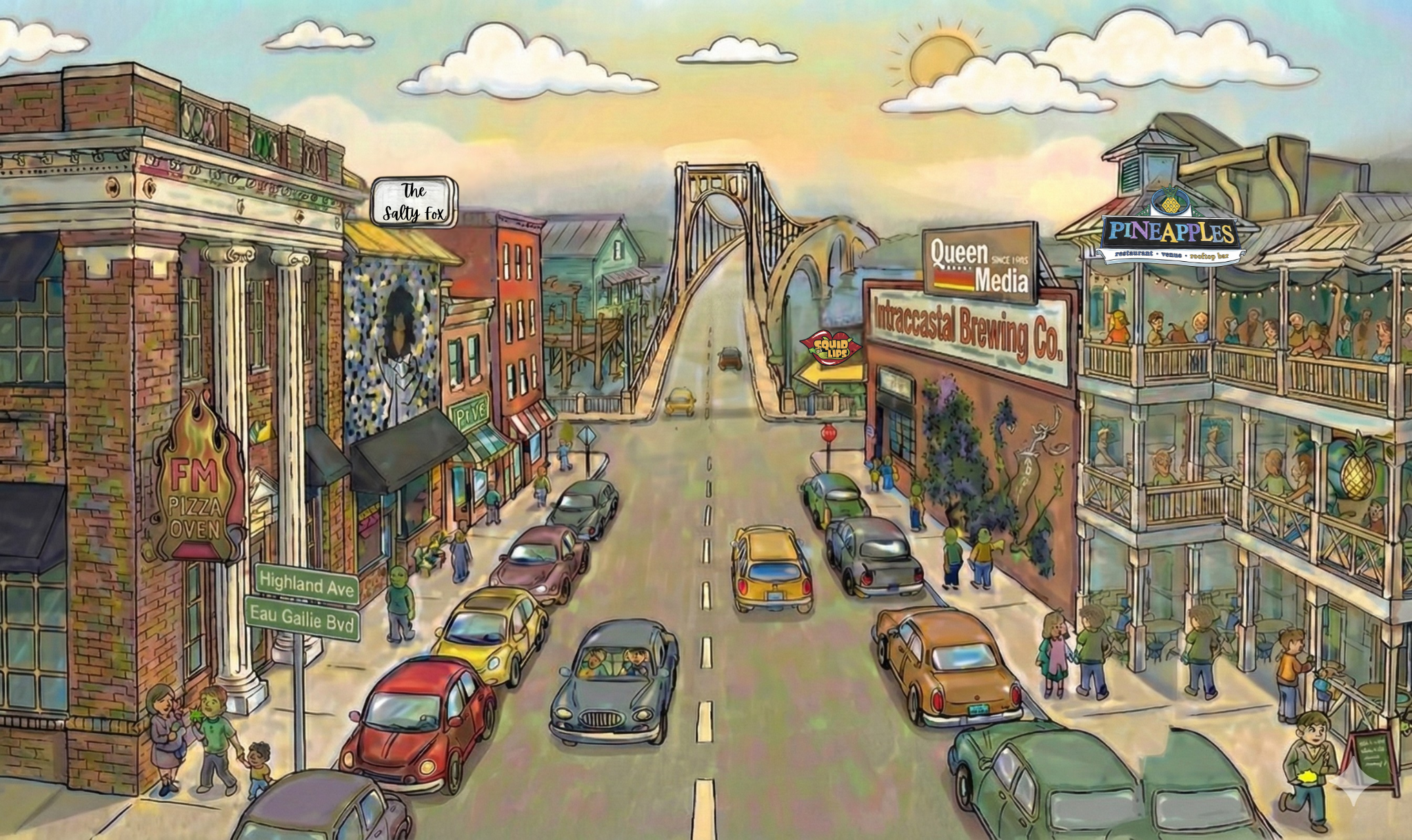
Intracoastal Brewing Company has emerged as the de facto community center of the new Eau Gallie. Located on Eau Gallie Boulevard, its open-air beer garden attracts a diverse demographic, from young families to retirees. The brewery’s integration of art (the Hoxxoh mural inside) and its role in hosting community events exemplify the "Third Place" theory—a social surrounding separate from the two usual social environments of home and the workplace.28
8.2 Culinary Destinations
The dining scene in Eau Gallie has moved upmarket, distinguishing itself from the chain-heavy corridors of Melbourne.
Pineapples: A three-story venue featuring a rooftop bar, concert venue, and restaurant. Its architecture takes advantage of the river views, capitalizing on the scenic location that first drew Gleason in 1860.30
Squid Lips: While more casual, this venue represents the "Old Florida" aesthetic, built on a pier over the river, offering a direct connection to the lagoon environment.28
The Salty Fox: A bar that caters to the "local dive" aesthetic but with a curated craft beer list, appealing to the younger demographic moving into the neighborhood.31
8.3 Curated Retail
The retail mix in EGAD is strictly anti-big box. Shops like Standard Collective (apparel and lifestyle) and Rehab Vintage Market (furniture) rely on a curatorial approach. They don't just sell items; they sell the "EGAD lifestyle"—aesthetic, historic, and unique. This aligns with the district's strategy to attract visitors looking for authenticity.31
9. Current Development Projects and Urban Tension (2025 Status)
As of late 2025, Eau Gallie is in the midst of its most significant physical transformation since the 1920s land boom.
9.1 The "Unscripted" Hotel Project
The site of the former Foosaner Art Museum is the location for a proposed luxury hotel, likely under the Unscripted brand (part of the Hyatt/Dream Hotel Group portfolio).33
Scale: The project envisions a 160-180 room hotel with rooftop amenities.
Controversy: While the developer (Larry Jarnes) has promised the hotel will be "art-centric," the demolition of a museum to build a hotel is a potent symbol of gentrification. Residents have expressed concern on forums and in city meetings about the scale of the building and its impact on the historic character of Highland Avenue.33
Status: As of late 2025, the project has received critical approvals, and the associated parking garage (a public-private partnership) is moving forward to address the chronic parking shortage in the district.35
9.2 The St. Clair Street Vision
The CRA has proposed a radical reimagining of St. Clair Street, which runs parallel to Highland Avenue. The "Vision Quest" plan involves creating an "S" curve roadway to slow traffic, installing art-inspired roundabouts, and developing new mixed-use retail and office space. This would effectively double the size of the walkable downtown core, reducing the pressure on Highland Avenue.36
10. Community Life: Rituals of the District
The social cohesion of Eau Gallie is maintained through a calendar of regular rituals that bring the community into the streets.
10.1 First Friday Art Walks
On the first Friday of every month, the district closes streets or expands pedestrian access for the Art Walk. This event is the economic lifeblood for many small galleries and artists. It features pop-up vendors, live music in Eau Gallie Square, and extended hours for brick-and-mortar shops. It is the primary mechanism by which the "Arts District" brand is performed and reinforced.37
10.2 The Loss of "Whiskey in the District"
For several years, "Whiskey in the District" was a major fundraising event for the EGAD main street program. However, reports indicate the 2025 event was cancelled due to "unforeseen challenges." This cancellation highlights the fragility of community events that rely heavily on volunteers and sponsorship in an increasingly expensive event market.39
10.3 Pineapple Park as the Public Commons
Pineapple Park, located at the river end of Pineapple Avenue, serves as the district's front porch. With its fishing pier, gazebo, and playground, it provides free public access to the Indian River Lagoon—a right that has been lost in many other Florida waterfront communities due to private development. The park is a popular viewing spot for rocket launches, linking the historic district to the technological identity of the Space Coast.40
11. Conclusion: The Future of "Rocky Water"
Eau Gallie is a place defined by its refusal to disappear. It survived the collapse of its agricultural dreams in the 1870s, the economic depression of the 1930s, and the political erasure of the 1969 merger. Today, it is reinventing itself again.
The tension in Eau Gallie today is between authenticity and development. The "Vibe Economy" relies on the authentic, gritty, historic feel of the neighborhood. Yet, the success of that economy attracts high-end development like the Unscripted Hotel, which threatens to sanitize the very character that made the district attractive in the first place.
As the bulldozers prepare to clear the site of the old art museum in 2026, Eau Gallie stands at a crossroads. Will it become a polished, boutique tourist destination, or can it maintain the "rocky," independent spirit that has defined it since William Henry Gleason first looked out over the coquina ridges in 1860? The answer lies in the continued engagement of its community, who, for over 160 years, have insisted that this place—regardless of what the maps say—is, and always will be, Eau Gallie.
