Queen Media News Exclusive: The Adderall Epidemic in Professional Esports
The Professional Esports Epidemic
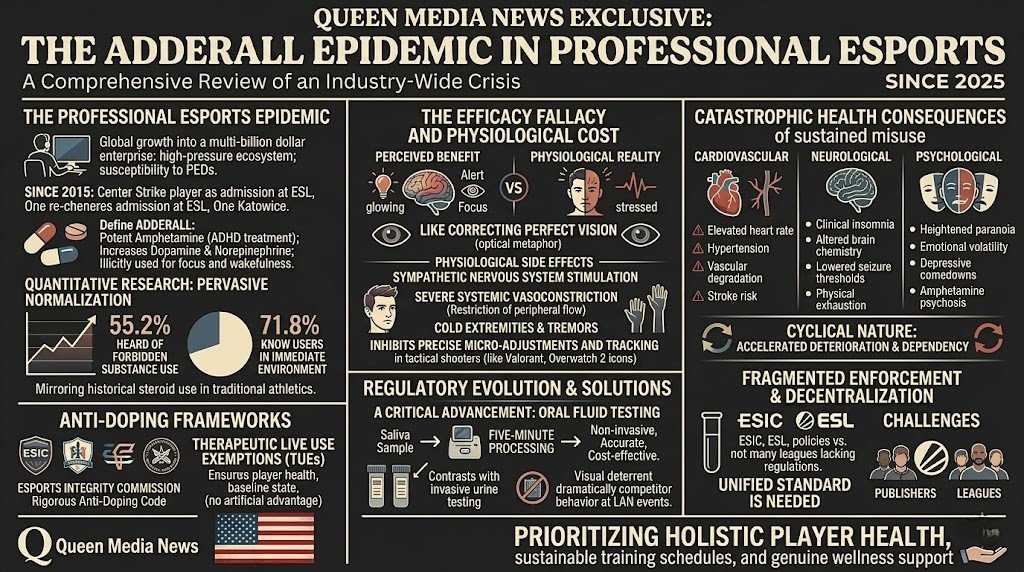
The global esports industry has transformed into a multi billion dollar enterprise, but this exponential growth has cultivated a high pressure ecosystem susceptible to the abuse of performance enhancing drugs. Since 2015, when a prominent professional Counter Strike player admitted his team utilized Adderall during the ESL One Katowice tournament, stimulant abuse has been formally recognized as an industry wide crisis. Designed to treat Attention Deficit Hyperactivity Disorder (ADHD), Adderall is a potent amphetamine that significantly increases extracellular dopamine and norepinephrine levels. Within the competitive gaming sphere, it is illicitly deployed to sustain intense focus and wakefulness during grueling, multi hour tournament brackets. Quantitative research highlights the pervasive normalization of this issue. A comprehensive survey of esports competitors revealed a profound cultural integration: 55.2% of respondents had heard of forbidden substances being used during major tournaments, and an alarming 71.8% acknowledged knowing individuals in their immediate gaming environment who utilized such stimulants. As financial stakes and global viewership metrics rise, many young players view amphetamines as an instrumental tool for career advancement, mirroring the historical use of anabolic steroids in traditional power athletics.
The Efficacy Fallacy and Physiological Cost
Despite the widespread locker room belief that Adderall inherently improves mechanical gaming ability, clinical experts and neuroscientists deeply dispute its efficacy for neurotypical individuals. Medical professionals frequently employ a straightforward optical metaphor: administering Adderall to a competitor without an ADHD diagnosis is akin to prescribing corrective lenses to someone who already possesses perfect vision. The user may experience a subjective illusion of heightened alertness and euphoria, but core neurocognitive parameters, such as complex tactical decision making, spatial reasoning, and dynamic team communication, remain fundamentally unenhanced. In reality, the physiological side effects of amphetamines actively degrade elite mechanical execution. Because Adderall powerfully stimulates the sympathetic nervous system, it causes severe systemic vasoconstriction, restricting peripheral blood flow. This vascular response results in cold extremities and tremors, which directly inhibit the precise micro adjustments and tracking required in top tier tactical shooters like Valorant and Overwatch 2.
Furthermore, the long term health consequences of sustained stimulant misuse are catastrophic. Prolonged abuse introduces severe risks to developing cardiovascular and neurological systems, threatening to terminate careers prematurely.
Cardiovascular: Elevated resting heart rate, systemic hypertension, accelerated vascular degradation, and increased stroke risk.
Neurological: Clinical insomnia, altered brain chemistry, lowered seizure thresholds, and systemic physical exhaustion.
Psychological: Heightened paranoia, extreme emotional volatility, severe depressive comedowns, and amphetamine induced psychosis.
The cyclical nature of the modern esports circuit exacerbates these dangers. Players quickly build a chemical tolerance, necessitating ever increasing dosages that accelerate physical deterioration and foster severe, career ending psychological dependency.
Regulatory Evolution and Oral Fluid Testing
To combat this epidemic, tournament operators have rapidly formalized aggressive anti doping frameworks. The Esports Integrity Commission (ESIC) was established to implement unified standards for competition integrity, utilizing a rigorous, medically sound Anti Doping Code. Because Adderall is a legally prescribed medication, ESIC employs Therapeutic Use Exemptions (TUEs). This ensures players with legitimate ADHD diagnoses can compete without sanction, provided the dosage solely returns them to a baseline state of health without conferring an artificial advantage.
A critical logistical advancement in this regulatory enforcement is the shift toward oral fluid testing. Historically, the World Anti Doping Agency relied heavily on urine matrices, which are highly invasive, easily adulterated, and entirely impractical in public esports arenas. Modern onsite saliva tests, which take merely five minutes to process, offer a non invasive, highly accurate, and cost effective alternative. The active deployment of these tests has dramatically altered competitor behavior; the highly visible nature of oral testing serves as a profound psychological deterrent, successfully suppressing Adderall use at major LAN events.
The High Stakes Pressure of the Pro Circuit
The root cause of this stimulant crisis is deeply embedded in the structure of professional gaming itself. The modern esports professional faces grueling, marathon like training schedules to maintain peak mechanical skills and strategic synergy. As the industry has matured, the pressure to perform has escalated exponentially. Millions of dollars in prize money, lucrative sponsorship deals, and the threat of being replaced by younger, faster talent create an intense psychological crucible. In this high stakes environment, Adderall abuse has morphed into an "open secret." Players often turn to these unprescribed stimulants not just for a perceived edge, but simply to push through long sessions and keep up with demanding schedules.
The prevalence extends beyond isolated incidents, with players from major tournaments like Counter Strike: Global Offensive admitting to team wide Adderall use during competition. Some players who have admitted to using prescription drugs claim these medications increase both the quality and duration of their gaming by helping to maintain focus, leading to a widespread phenomenon in the esport world. Professional players, including former Call of Duty Champion Adam Sloss, report that they frequently witness this type of drug use at competitions. Even though some leagues are implementing drug testing protocols, abuse persists due to intense competitive pressure and the substantial financial rewards in professional esports.
Unfortunately, the decentralized nature of esports complicates widespread enforcement. Unlike traditional sports, esports consists of various publishers, tournament organizers, and independent leagues. While organizations like ESIC and the Electronic Sports League (ESL) have pioneered anti doping policies in response to public doping admissions, many other leagues still lack clear substance use regulations or the necessary infrastructure to enforce them. This fragmented regulatory landscape means that while top tier LAN tournaments might employ testing, the vast majority of online qualifiers and lower tier professional brackets remain largely unmonitored. Until the entire professional circuit adopts a unified, rigorous standard, coupled with genuine support for player mental wellness and burnout prevention, the temptation to abuse stimulants will remain a shadow over the sport.
Conclusion
The global esports industry stands at a critical juncture regarding its reliance on performance enhancing stimulants. As international regulatory bodies implement rigorous, non invasive testing protocols, the professional circuit must evolve beyond punitive measures. True clean gaming will require a cultural shift within professional organizations, prioritizing holistic player health, sustainable training schedules, and unified global regulations. By protecting their athletes from the intense pressures that drive chemical dependency, the esports industry can ensure a safe environment for long term, sustained peak performance across the rapidly expanding competitive landscape.
Sponsored by EWO Sliders (321) 506-6367
